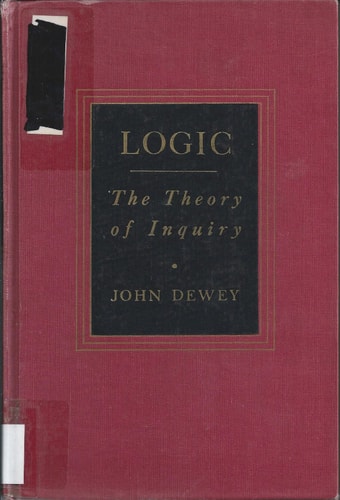
Logic: The Theory of Enquiry
0
0
As an Amazon Associate and affiliate partner, Menrva Books earns from qualifying purchases. Learn more
Author Description
In this classic work, John Dewey argues that logic is not a static set of formal rules, but a functional process of inquiry. He examines how human beings use logic to resolve problematic situations, transforming them into unified, settled ones. Dewey's approach emphasizes the practical, experimental nature of thought, bridging the gap between common sense and scientific inquiry.
Menrva's Summary
THE THESIS
This work investigates the fundamental nature of inquiry, arguing that logic is not a static set of formal rules but a functional process of resolving problematic situations. John Dewey, a prominent American philosopher and educational reformer, utilizes his background in pragmatism to redefine logic as the method by which human beings transform indeterminate situations into unified, settled ones. He posits that all logical forms arise from the practical requirements of inquiry rather than from a priori structures of the mind.
THE SCOPE MAP
What You Will Find
- A comprehensive theory of inquiry as a transactional process between organism and environment
- Analysis of the relationship between common sense and scientific inquiry
- Examination of propositions, judgments, and the structure of logical theory
- Critique of traditional formal logic and its limitations in practical application
Scope Limits
- The text does not provide a manual for symbolic logic or mathematical notation
- It avoids abstract metaphysical speculation in favor of functionalist analysis
THE AUTHORITY PERSPECTIVE
Scholars and philosophers frequently cite this text as a foundational document for understanding the pragmatist approach to logic and scientific methodology. Readers often note the academic density of the prose, which requires careful engagement with Dewey's specific terminology regarding transactional realism.
Page Count:
554
Publication Date:
1938-12-01
Publisher:
Holt, R & W
ISBN-10:
0030052505
ISBN-13:
9780030052507
Philosophy
Pragmatism
Logic
Epistemology
Community Tags
Similar Books