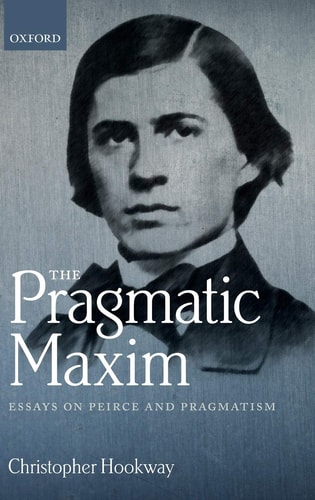
The Pragmatic Maxim: Essays on Peirce and Pragmatism
0
0
As an Amazon Associate and affiliate partner, Menrva Books earns from qualifying purchases. Learn more
Author Description
Christopher Hookway presents a series of essays on the philosophy of Charles Sanders Peirce (1839-1913), the "founder of pragmatism" and one of the most important and original American philosophers. Peirce made significant contributions to the development of formal logic and to the study of the normative standards we should follow in carrying out inquiries and enhancing our knowledge in science and mathematics. In The Pragmatic Maxim, Hookway explores Peirce's writings on truth, science, and the nature of meaning, which have become steadily more influential over recent decades. He demonstrates how Peirce's ideas can contribute to and inform philosophical understanding in debates that continue today.The first seven chapters explore the framework of Peirce's thought, especially his fallibilism and his rejection of scepticism, and his contributions to the pragmatist understanding of truth and reality. Like Frege and Husserl, among others, Peirce rejected psychologism and used phenomenological foundations to defend the system of categories. The final three chapters are concerned with 'the pragmatic maxim', a rule for clarifying the contents of concepts and ideas. Hookway explores the different strategies Peirce employed to demonstrate the correctness of the maxim, and thus of pragmatism. As well as studying and evaluating Peirce's views, The Pragmatic Maxim discusses the relations between the views of Peirce and other pragmatist philosophers such as William James, C. I. Lewis, and Richard Rorty.
Menrva's Summary
THE THESIS
This collection of essays investigates the foundational principles of Charles Sanders Peirce’s philosophy and the practical application of his pragmatic maxim. Christopher Hookway, a noted scholar of Peircean thought, examines the intersection of logic, scientific inquiry, and meaning. By analyzing Peirce’s rejection of skepticism and his defense of fallibilism, the author provides a rigorous framework for understanding how these historical ideas inform contemporary philosophical debates.
THE SCOPE MAP
What You Will Find
- An analysis of Peirce's fallibilism and his rejection of skepticism.
- A detailed examination of the pragmatic maxim as a tool for conceptual clarification.
- Comparative studies between Peirce and other pragmatist thinkers like William James, C. I. Lewis, and Richard Rorty.
- A discussion on the phenomenological foundations of Peirce's system of categories.
THE AUTHORITY PERSPECTIVE
Experts recognize this work as a significant contribution to the study of American pragmatism, particularly for its clear articulation of complex logical and epistemological concepts. Readers frequently note the academic density of the prose, which is best suited for those already familiar with the history of analytic philosophy.
Page Count:
256
Publication Date:
2013-01-06
Publisher:
Oxford University Press
ISBN-10:
0199588384
ISBN-13:
9780199588381
Philosophy
Logic
Epistemology
American Philosophy
Pragmatism
Community Tags
Similar Books