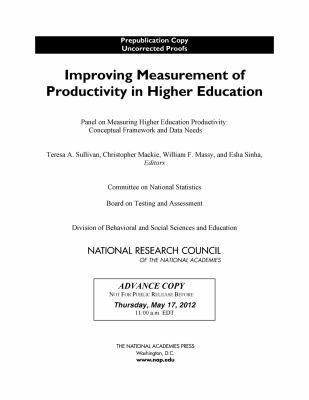
Improving Measurement of Productivity in Higher Education: Panel on Measuring Higher Education Productivity: Conceptual Framework and Data Needs
0
0
As an Amazon Associate and affiliate partner, Menrva Books earns from qualifying purchases. Learn more
Author Description
Higher education is a linchpin of the American economy and society: teaching and research at colleges and universities contribute significantly to the nation's economic activity, both directly and through their impact on future growth; federal and state governments support teaching and research with billions of taxpayers' dollars; and individuals, communities, and the nation gain from the learning and innovation that occur in higher education. In the current environment of increasing tuition and shrinking public funds, a sense of urgency has emerged to better track the performance of colleges and universities in the hope that their costs can be contained without compromising quality or accessibility. Improving Measurement of Productivity in Higher Education presents an analytically well-defined concept of productivity in higher education and recommends empirically valid and operationally practical guidelines for measuring it. In addition to its obvious policy and research value, improved measures of productivity may generate insights that potentially lead to enhanced departmental, institutional, or system educational processes. Improving Measurement of Productivity in Higher Education constructs valid productivity measures to supplement the body of information used to guide resource allocation decisions at the system, state, and national levels and to assist policymakers who must assess investments in higher education against other compelling demands on scarce resources. By portraying the productive process in detail, this report will allow stakeholders to better understand the complexities of--and potential approaches to--measuring institution, system and national-level performance in higher education.--Publisher's description.
Menrva's Summary
THE THESIS
This report addresses the critical need for improved measurement of productivity within higher education institutions. The book constructs an analytically well-defined concept of productivity and recommends practical guidelines for its measurement, aiming to inform policy and research. It details the productive process to help stakeholders understand how to measure performance at institutional, system, and national levels, thereby aiding resource allocation decisions and assessments of investment in higher education.
THE SCOPE MAP
- An analytically well-defined concept of productivity in higher education.
- Empirically valid and operationally practical guidelines for measuring productivity.
- Detailed portrayal of the productive process in higher education.
- Insights into potential approaches for enhanced departmental, institutional, or system educational processes.
- Measures to supplement information guiding resource allocation decisions.
- Assistance for policymakers assessing investments in higher education.
THE AUTHORITY PERSPECTIVE
This report is positioned as a vital resource for understanding and improving the efficiency of higher education institutions. The framework it provides is intended to support policymakers and administrators in making informed decisions regarding resource allocation and investment. By offering concrete methods for measuring productivity, the book aims to contribute to containing costs without compromising the quality or accessibility of education.
Page Count:
210
Publication Date:
2012-01-01
ISBN-10:
0309257743
ISBN-13:
9780309257749
Non-Fiction
Economics
Business
Policy
Research
Data Analysis
Higher Education
Community Tags
Similar Books