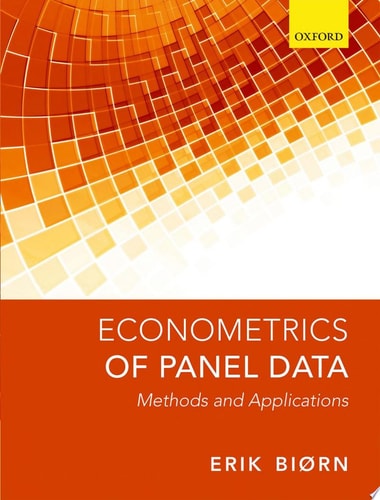
Econometrics of Panel Data: Methods and Applications
0
0
As an Amazon Associate and affiliate partner, Menrva Books earns from qualifying purchases. Learn more
Author Description
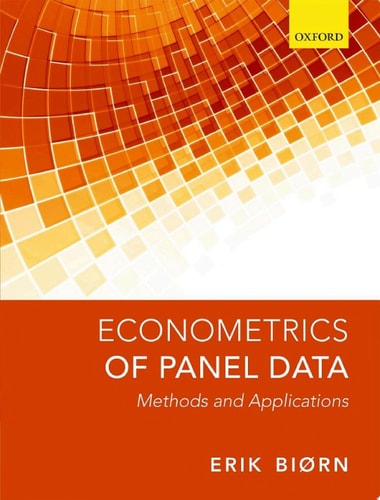
Panel data is a data type increasingly used in research in economics, social sciences, and medicine. Its primary characteristic is that the data variation goes jointly over space (across individuals, firms, countries, etc.) and time (over years, months, etc.). Panel data allow examination of problems that cannot be handled by cross-section data or time-series data. Panel data analysis is a core field in modern econometrics and multivariate statistics, and studies based on such data occupy a growing part of the field in many other disciplines. The book is intended as a text for master and advanced undergraduate courses. It may also be useful for PhD-students writing theses in empirical and applied economics and readers conducting empirical work on their own. The book attempts to take the reader gradually from simple models and methods in scalar (simple vector) notation to more complex models in matrix notation. A distinctive feature is that more attention is given to unbalanced panel data, the measurement error problem, random coefficient approaches, the interface between panel data and aggregation, and the interface between unbalanced panels and truncated and censored data sets. The 12 chapters are intended to be largely self-contained, although there is also natural progression. Most of the chapters contain commented examples based on genuine data, mainly taken from panel data applications to economics. Although the book, inter alia, through its use of examples, is aimed primarily at students of economics and econometrics, it may also be useful for readers in social sciences, psychology, and medicine, provided they have a sufficient background in statistics, notably basic regression analysis and elementary linear algebra.
Menrva's Summary
THE THESIS
This text investigates the methodological framework and practical application of panel data analysis in modern econometrics. Erik Biørn, an established academic in the field, provides a structured pedagogical approach that transitions from scalar notation to complex matrix algebra. The book serves as a comprehensive guide for students and researchers to address empirical problems that require the simultaneous analysis of cross-sectional and time-series dimensions.
THE SCOPE MAP
What You Will Find
- Methodologies for handling unbalanced panel data
- Analysis of measurement error problems and random coefficient approaches
- Examination of the interface between panel data and aggregation
- Techniques for managing truncated and censored data sets
Scope Limits
- Requires foundational knowledge in basic regression analysis and elementary linear algebra
- Focuses primarily on economic applications rather than exhaustive coverage of non-economic social science fields
THE AUTHORITY PERSPECTIVE
Experts recognize this work as a rigorous resource for master and PhD-level students in economics. Readers frequently note the academic density of the prose, which is balanced by the inclusion of commented examples based on genuine data sets.
Page Count:
416
Publication Date:
2016-01-01
Publisher:
OUP Oxford
ISBN-10:
019106789X
ISBN-13:
9780191067891
Economics
Business Statistics
Statistics
Data Analysis
Econometrics
Mathematics
Community Tags
Similar Books