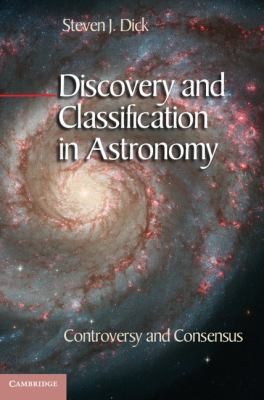
Discovery and Classification in Astronomy: Controversy and Consensus
0
0
As an Amazon Associate and affiliate partner, Menrva Books earns from qualifying purchases. Learn more
Author Description
Astronomical discovery involves more than detecting something previously unseen. The reclassification of Pluto as a dwarf planet in 2006, and the controversy it generated, shows that discovery is a complex and ongoing process - one comprising various stages of research, interpretation, and understanding. Ranging from Galileo's observation of Jupiter's satellites, Saturn's rings, and star clusters, to Herschel's nebulae and the modern discovery of quasars and pulsars, Steven J. Dick's comprehensive history identifies the concept of "extended discovery" as the engine of progress in astronomy. The text traces more than 400 years of telescopic observation, exploring how the signal discoveries of new astronomical objects relate to and inform one another, and why controversies such as Pluto's reclassification are commonplace in the field. The volume is complete with a detailed classification system for known classes of astronomical objects, offering students, researchers, and amateur observers a valuable reference and guide
Menrva's Summary
THE THESIS
The process of astronomical discovery is far more than simply observing the unknown; it is a complex, iterative journey of research, interpretation, and evolving understanding. Steven J. Dick, a historian of science, examines over 400 years of telescopic observation to identify the concept of "extended discovery" as the driving force behind progress in astronomy. The book explores how individual discoveries, from Galileo's observations to the identification of quasars and pulsars, inform and build upon one another, often leading to significant controversies such as the reclassification of Pluto. Dick argues that these debates are not anomalies but are commonplace and integral to the advancement of astronomical knowledge.
THE SCOPE MAP
- A comprehensive history of astronomical discovery spanning over 400 years.
- Analysis of key discoveries from Galileo to modern astrophysics, including nebulae, quasars, and pulsars.
- Exploration of the concept of "extended discovery" as a model for scientific progress.
- Detailed examination of controversies in astronomy, using Pluto's reclassification as a central case study.
- A classification system for known classes of astronomical objects.
- Insights into the relationship between new discoveries and existing interpretations.
- Discussion on the ongoing nature of scientific understanding and reclassification.
THE AUTHORITY PERSPECTIVE
This volume is regarded as a comprehensive historical account of astronomical discovery and its inherent controversies. The author's focus on "extended discovery" and the detailed classification system offer significant value to students, researchers, and amateur astronomers alike. The book is noted for its thorough exploration of how new observations and interpretations shape our understanding of the cosmos, making it a key reference for those interested in the history and philosophy of astronomy.
Page Count:
458
Publication Date:
2013-01-01
ISBN-10:
1107033616
ISBN-13:
9781107033610
History
Non-Fiction
Science
Classification Systems
Astronomy
Scientific Discovery
Community Tags
Similar Books