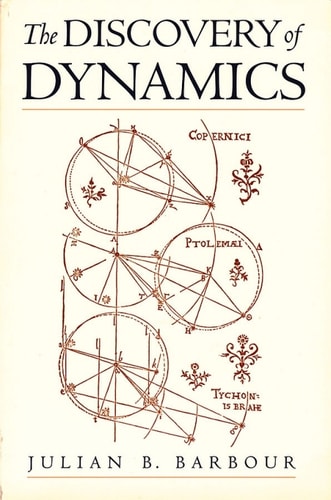
The Discovery of Dynamics: A Study from a Machian Point of View of the Discovery and the Structure of Dynamical Theories
0
0
As an Amazon Associate and affiliate partner, Menrva Books earns from qualifying purchases. Learn more
Author Description
Ever since Newton created dynamics, there has been controversy about its foundations. Are space and time absolute? Do they form a rigid but invisible framework and container of the universe? Or are space, time, and motion relative? If so, does Newton's 'framework' arise through the influence of the universe at large, as Ernst Mach suggested? Einstein's aim when creating his general theory of relativity was to demonstrate this and thereby implement 'Mach's Principle'. However, it is widely believed that he achieved only partial success. This question of whether motion is absolute or relative has been a central issues in philosophy; the nature of time has perennial interest. Current attempts to create a quantum description of the whole universe keep these issues at the cutting edge of modern research. Written by the world's leading expert on Mach's Principle, The Discovery of Dynamics is a highly original account of the development of notions about space, time, and motion. Widely praised in its hardback version, it is one of the fullest and most readable accounts of the astronomical studies that culminated in Kepler's laws of planetary motion and of the creation of dynamics by Galileo, Descartes, Huygens, and Newton. Originally published as Absolute or Relative Motion?, Vol. 1: The Discovery of Dynamics (Cambridge), The Discovery of Dynamics provides the technical background to Barbour's recently published The End of Time, in which he argues that time disappears from the description of the quantum universe.
Menrva's Summary
THE THESIS
This work investigates the fundamental nature of space, time, and motion by examining the historical development of dynamical theories through the lens of Mach's Principle. Julian B. Barbour, a recognized authority on the subject, utilizes a detailed historical analysis of astronomical and physical discoveries to challenge the Newtonian concept of absolute space and time. The text argues that the framework of dynamics arises from the influence of the universe at large, providing a rigorous technical foundation for understanding the transition from classical mechanics to modern quantum cosmology.
THE SCOPE MAP
What You Will Find
- Historical analysis of astronomical studies leading to Kepler's laws of planetary motion.
- Detailed examination of the contributions of Galileo, Descartes, Huygens, and Newton to the creation of dynamics.
- Technical exploration of the debate between absolute and relative motion.
Scope Limits
- The text focuses primarily on the historical and theoretical development of dynamics rather than providing a comprehensive manual for modern experimental physics.
- It does not cover the full breadth of quantum mechanics beyond the specific context of the author's arguments regarding the nature of time.
THE AUTHORITY PERSPECTIVE
Experts and scholars in the history and philosophy of physics regard this text as a foundational resource for understanding the evolution of Machian thought. Readers frequently note the technical density of the prose, which requires a solid background in physics to fully grasp the implications of the author's arguments.
Page Count:
772
Publication Date:
2001-01-01
Publisher:
Oxford University Press
ISBN-10:
019028515X
ISBN-13:
9780190285159
Science
History
Words Language & Grammar
Dynamics
Reference
Physics
Self Service
Kindle Store
Relativity
Kindle eBooks
Philosophy of
Earth Sciences
Linguistics
Categories
Philosophy history
Astronomy
Science History
Custom Stores
Modern Physics
Community Tags
Similar Books