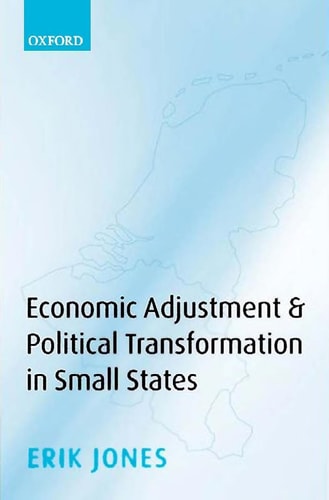
Economic Adjustment and Political Transformation in Small States
0
0
As an Amazon Associate and affiliate partner, Menrva Books earns from qualifying purchases. Learn more
Author Description
The smaller countries of Western Europe have a reputation for being more successful than their larger neighbors. They are wealthier per capita, they are more stable politically, and they are more flexible economically. The secret to this success lies in their consensual style of politics and their corporatist style of decision-making. Unfortunately, however, that may be about to change. A political transformation underway in small states is undermining the politics of consensus and breakdown the effectiveness of corporatist institutions. Small countries are becoming increasingly vulnerable to the vicissitudes of world markets as a result.Belgium and the Netherlands offer clear examples of the problem at hand. The political societies of both countries were tightly organized to avoid conflict and to promote consensus. Over time, however, this tight organization has broken down, politicians have opted for conflict over consensus, and elections have become more volatile as a result. In turn, this political transformation of Belgium and the Netherlands has undermined their traditional approach to economic policymaking and economic adjustment. Belgium and the Netherlands are now more vulnerable to world market forces than at any time since the end of the 1970s. Their relative economic and political success can no longer be taken for granted. The relative success of other small states should be brought into question as well.
Menrva's Summary
THE THESIS
This book investigates whether the traditional economic and political stability of small Western European states is being eroded by a shift away from consensual, corporatist decision-making. Dr. Erik Jones, a scholar of European political economy, utilizes a comparative analysis of Belgium and the Netherlands to examine how internal political fragmentation impacts national economic resilience. The author argues that the decline of institutionalized consensus mechanisms leaves these nations increasingly exposed to the volatility of global market forces. By tracing the evolution of these political systems, the text provides a framework for understanding the fragility of the small-state model in a modern globalized context.
THE SCOPE MAP
What You Will Find
- Comparative analysis of political and economic structures in Belgium and the Netherlands.
- Examination of the transition from corporatist decision-making to conflict-oriented political strategies.
- Assessment of national vulnerability to global market fluctuations since the 1970s.
- Theoretical framework linking domestic political consensus to economic adjustment capabilities.
THE AUTHORITY PERSPECTIVE
Experts recognize this work as a significant contribution to the study of European political economy and the institutional challenges facing small states. Readers frequently note the academic rigor of the analysis and its clear application of political science theories to historical economic trends.
Page Count:
256
Publication Date:
2008-07-15
Publisher:
Oxford University Press
ISBN-10:
0199208336
ISBN-13:
9780199208333
Economics
Comparative Government
International relations
Politics & Government
European History
Public Policy
Europe
Corporate State
Community Tags
Similar Books