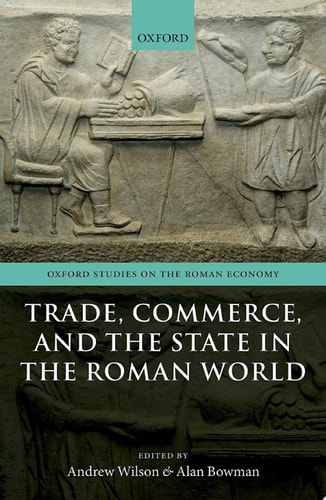
Trade, Commerce, and the State in the Roman World
0
0
As an Amazon Associate and affiliate partner, Menrva Books earns from qualifying purchases. Learn more
Author Description
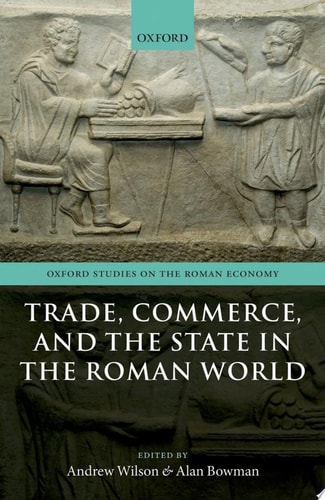
This volume presents eighteen papers by leading Roman historians and archaeologists discussing trade in the Roman Empire during the period c.100 BC to AD 350. It focuses especially on the role of the Roman state in shaping the institutional framework for trade within and outside the empire, in taxing that trade, and in intervening in the markets to ensure the supply of particular commodities, especially for the city of Rome and for the army. As part of a novel interdisciplinary approach to the subject, the chapters address its myriad facets on the basis of broadly different sources of evidence: historical, papyrological, and archaeological. They are grouped into three sections, covering institutional factors (taxation, legal structures, market regulation, financial institutions); evidence for long-distance trade within the empire in wood, stone, glass, and pottery; and trade beyond the frontiers, with the east (as far as China), India, Arabia, the Red Sea, and the Sahara. Rome's external trade with realms to the east emerges as being of particular significance, but it is in the eastern part of the empire itself where the state appears to have adapted the mechanisms of taxation in collaboration with the elite holders of wealth to support its need for revenue. On the other hand, the price of that collaboration, which was in effect a fiscal partnership, ultimately led in the longer term in slightly different forms in the east and the west to a fundamental change in the political character of the empire.
Menrva's Summary
THE THESIS
This volume investigates the complex interplay between the Roman state and commercial activity, specifically examining how institutional frameworks and fiscal policies shaped economic life from 100 BC to AD 350. Edited by Alan Bowman and Andrew Wilson, the collection synthesizes contributions from leading historians and archaeologists to analyze how the state intervened in markets to secure supplies for the military and the capital city. The authors argue that the fiscal partnership between the state and wealthy elites, particularly in the eastern provinces, fundamentally altered the political structure of the empire over time.
THE SCOPE MAP
What You Will Find
- Analysis of institutional factors including taxation, legal structures, and market regulation
- Evidence for long-distance trade in commodities such as wood, stone, glass, and pottery
- Examination of trade networks extending to China, India, Arabia, and the Sahara
- Interdisciplinary methodology utilizing historical, papyrological, and archaeological sources
Scope Limits
- The study focuses primarily on the period between 100 BC and AD 350
- The analysis is restricted to the Roman Empire and its immediate external trade partners
THE AUTHORITY PERSPECTIVE
Scholars and historians recognize this volume as a significant contribution to the study of the Roman economy, particularly for its interdisciplinary approach to institutional history. Readers frequently note the academic density of the prose and the rigorous use of diverse primary source evidence to support the authors' arguments.
Page Count:
678
Publication Date:
2017-01-01
Publisher:
OUP Oxford
ISBN-10:
0192507974
ISBN-13:
9780192507976
Economics
History
English & College Success
Europe
Trade and Commerce
Roman Empire
Commerce
Archaeology
History of Architecture
International business
Professional Career & Trade
Ancient History
English