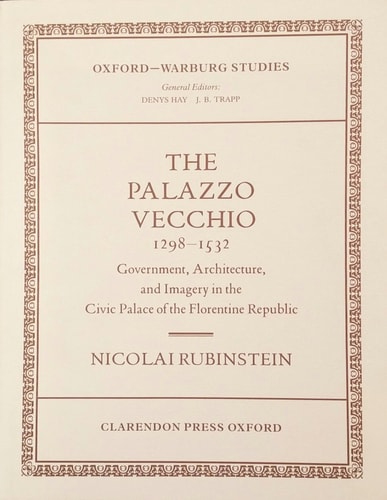
The Palazzo Vecchio, 1298-1532: Government, Architecture, and Imagery in the Civic Palace of the Florentine Republic
0
0
As an Amazon Associate and affiliate partner, Menrva Books earns from qualifying purchases. Learn more
Author Description
Nicolai Rubinsteins's unique command of the complexities of Florentine political history has resulted in an extremely impressive study of the Palazzo Vecchio and the way in whch it functioned as the seat of the Florentine republican government from the late thirteenth century to 1530. Professor Rubinstein's study makes a fundamental contribution to the subject and arrives at a number of new and important conclusions.
Menrva's Summary
THE THESIS
This study investigates how the architectural evolution and decorative programs of the Palazzo Vecchio reflected the shifting political ideologies of the Florentine Republic between 1298 and 1532. Nicolai Rubinstein, a renowned historian of the Italian Renaissance, utilizes archival records and primary source analysis to map the intersection of civic administration and physical space. He argues that the palace served not merely as a functional government building, but as a deliberate instrument of political communication and republican identity. The work provides a rigorous examination of how the building's structural changes mirrored the turbulent transitions in Florentine governance.
THE SCOPE MAP
What You Will Find
- Detailed analysis of the architectural development of the Palazzo Vecchio from the late thirteenth century to the fall of the Republic.
- Examination of the relationship between civic government functions and the spatial layout of the palace.
- Interpretation of the iconographic and artistic programs commissioned to represent Florentine political values.
- Historical context regarding the transition from communal government to the Medici-dominated era.
THE AUTHORITY PERSPECTIVE
Scholars and historians regard this work as a foundational text for understanding the intersection of Renaissance political history and civic architecture. Readers frequently note the academic density of the prose, which provides a comprehensive and authoritative account of the palace's role in Florentine life.
Page Count:
214
Publication Date:
1995-11-09
Publisher:
Oxford University Press
ISBN-10:
0199206023
ISBN-13:
9780199206025
History
Architecture
Art History
Political History
Florence Italy
Italy
Community Tags
Similar Books