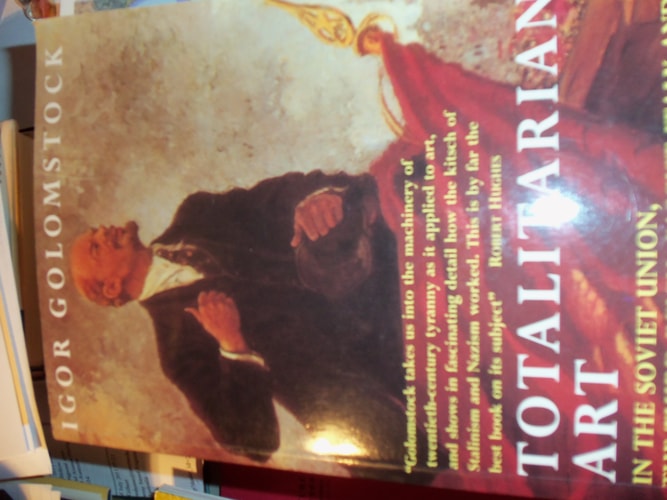
Totalitarian Art
0
0
As an Amazon Associate and affiliate partner, Menrva Books earns from qualifying purchases. Learn more
Author Description
Totalitarian Art achieves nothing less than a thorough and serious comparative study of the official art of Stalin's Russia, Hitler's Germany, Mussolini's Italy, Kim Jong-Il's North Korea, and Saddam Hussein's Iraq.In the Soviet Union, and later in Maoist China, theories of mass artistic appeal were used to promote the Revolution both at home and abroad. In Nazi Germany and Fascist Italy they asserted the putative grandeur of the epoch. All too often, art that served the Revolution or the new millennial society became?total realism,? and always it became a slave to the state and the cult of personality, and ultimately one more weapon in the arsenal of oppression.Igor Golomstock gives a detailed appraisal of the forms that define totalitarian art and illustrates his text with more than two hundred examples of its paintings, posters, sculpture and architecture, and includes a powerful comparative visual essay which demonstrates the eerie similarity of the official art of these very different regimes.
Menrva's Summary
THE THESIS
This work investigates the striking visual and thematic commonalities found in the state-sanctioned art of twentieth-century totalitarian regimes. Igor Golomstock, an art historian who experienced the Soviet system firsthand, utilizes a comparative methodology to analyze how diverse regimes—from Stalinist Russia to Nazi Germany—employed aesthetic production as a primary instrument of political control and personality cult maintenance. By examining the intersection of artistic form and state ideology, the author demonstrates how these disparate governments arrived at remarkably similar visual languages to enforce conformity and project power.
THE SCOPE MAP
What You Will Find
- Comparative analysis of official art in Stalinist Russia, Nazi Germany, Fascist Italy, Maoist China, North Korea, and Saddam Hussein's Iraq.
- Examination of the transition from avant-garde experimentation to the rigid constraints of total realism.
- Over two hundred visual examples including paintings, posters, sculpture, and architecture.
- A visual essay highlighting the recurring motifs of the hero, the leader, and the idealized state.
THE AUTHORITY PERSPECTIVE
This text is regarded as a foundational comparative study that bridges the gap between art history and political science. The analysis provides a rigorous, scholarly framework for understanding how visual culture functions as a mechanism of state oppression across different ideological landscapes.
Page Count:
432
Publication Date:
1991-10-14
Publisher:
Vintage/Ebury (A Division of Random House Group)
ISBN-10:
0002721694
ISBN-13:
9780002721691
History
Art
Italy
Propaganda
Russia
Germany
Art History
China
Design history