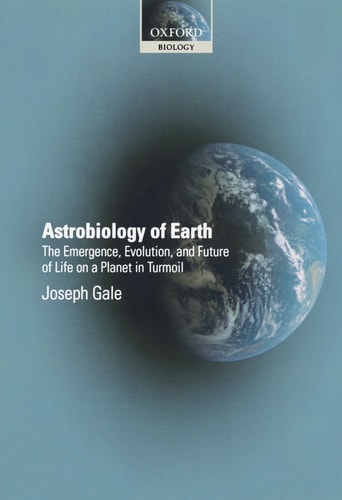
Astrobiology of Earth: The Emergence, Evolution and Future of Life on a Planet in Turmoil
0
0
As an Amazon Associate and affiliate partner, Menrva Books earns from qualifying purchases. Learn more
Author Description
The study of life in our universe has been given the name 'astrobiology'. It is a relatively new subject, but not a new discipline since it brings together several mature fields of science including astronomy, geology, biology, and climatology. An understanding of the singular conditions that allowed the only example of life that we know exists to emerge and survive on our turbulent planet is essential if we are to seek answers to two fundamental questions facing humanity: will life (and especially human life) continue on Earth, and does life exist elsewhere in the universe?Astrobiology of Earth adopts a unique approach that differs from most texts in the field which focus on the possibility of extraterrestrial life. In contrast, the central theme of this book is the fortuitous combination of numerous cosmic factors that together produced the special environment which enabled the emergence, persistence and evolution of life on our own planet, culminating in humanity. This environment has been subject to constant and chaotic change during life's 3.6 billion year history. The geologically very recent appearance of humans and their effect on the biosphere is discussed in relation to its deterioration as well as climate change. The search for extraterrestrial life is considered with a view to the suggestion that humans may escape a depleted Earth by colonizing the universe.This book contributes to our understanding of astrobiology from the perspective of life on Earth and especially human welfare and survival. Astronomical and geological phenomena are related in turn to their biological relevance and impact. This introductory text assumes little or no prior knowledge of more specialized scientific fields and is designed for undergraduate and graduate level students taking related courses in departments of biology, earth science/geology, and environmental science. It will also serve as a useful biology primer for astronomy majors.
Menrva's Summary
THE THESIS
This book investigates the singular cosmic and geological conditions that enabled the emergence, persistence, and evolution of life on Earth, while questioning the long-term viability of human life on a changing planet. Joseph Gale, drawing on his background in the biological and earth sciences, synthesizes data from astronomy, geology, and climatology to construct a framework for understanding Earth as a unique biological laboratory. The text argues that the fortuitous combination of planetary factors has sustained life for 3.6 billion years, yet current human activity threatens this stability, necessitating a critical look at our future both on Earth and potentially elsewhere in the universe.
THE SCOPE MAP
What You Will Find
- A 3.6 billion-year historical analysis of Earth's biosphere and its response to chaotic environmental change.
- An interdisciplinary methodology linking astronomical phenomena to biological outcomes.
- Examination of human impact on the biosphere, including climate change and environmental deterioration.
- A critical evaluation of the feasibility of human colonization of the universe as a response to planetary depletion.
THE AUTHORITY PERSPECTIVE
Experts and educators identify this text as an accessible primer for undergraduate and graduate students across the biological and earth sciences. Readers frequently note that the prose remains clear and approachable, effectively bridging the gap between specialized scientific fields for those with little prior knowledge.
Page Count:
240
Publication Date:
2009-05-15
Publisher:
Oxford University Press
ISBN-10:
0199205817
ISBN-13:
9780199205813
Science
Geology
Biology
Life
Climatology
Earth Science
Astrobiology
Exobiology
Evolution
Community Tags
Similar Books