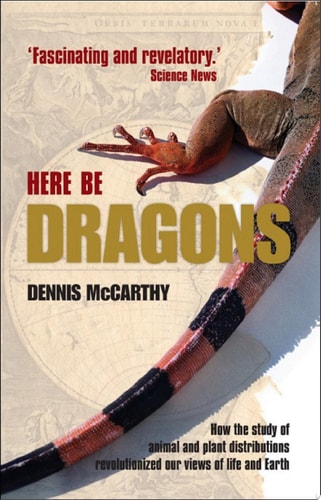
Here Be Dragons: How the study of animal and plant distributions revolutionized our views of life and Earth
0
0
As an Amazon Associate and affiliate partner, Menrva Books earns from qualifying purchases. Learn more
Author Description
Why do we find polar bears only in the Arctic and penguins only in the Antarctic? Why do oceanic islands often have many types of birds but no large native mammals? As Charles Darwin and Alfred Russel Wallace travelled across distant lands studying the wildlife they both noticed that the distribution of plants and animals formed striking patterns - patterns that held strong clues to the past of the planet. The study of the spatial distribution of living things is known as biogeography. It is a field that could be said to have begun with Darwin and Wallace. In this lively book, Denis McCarthy tells the story of biogeography, from the 19th century to its growth into a major field of interdisciplinary research in the present day. It is a story that encompasses two great, insightful theories that were to provide the explanations to the strange patterns of life across the world - evolution, and plate tectonics. We find animals and plants where we do because, over time, the continents have moved, separating and coalescing in a long, slow dance; because sea levels have risen, cutting off one bit of land from another, and fallen, creating land bridges; because new and barren volcanic islands have risen up from the sea; and because animals and plants vary greatly in their ability to travel, and separation has caused the formation of new species. The story of biogeography is the story of how life has responded and has in turn altered the ever changing Earth. It is a narrative that includes many fascinating tales - of pygmy mammoths and elephant birds; of changing landscapes; of radical ideas by bold young scientists first dismissed and later, with vastly growing evidence, widely accepted. The story is not yet done: there are still questions to be answered and biogeography is a lively area of research and debate. But our view of the planet has been changed profoundly by biogeography and its related fields: the emerging understanding is of a deeply interconnected system in whic
Menrva's Summary
THE THESIS
How does the spatial distribution of flora and fauna across the globe serve as a primary indicator for the historical evolution of life and the geological transformation of the Earth? Dennis Patrick McCarthy, a researcher in the field, synthesizes the development of biogeography from its 19th-century origins to its modern interdisciplinary status. The book argues that the patterns observed by early naturalists like Darwin and Wallace are best explained through the dual lenses of evolutionary biology and plate tectonics. By examining the movement of continents and the dispersal capabilities of various species, the author provides a framework for understanding the current biological landscape of the planet.
THE SCOPE MAP
What You Will Find
- Historical development of biogeography from the 19th century to the present.
- Analysis of the interplay between plate tectonics and species distribution.
- Case studies on island biogeography and the impact of sea-level fluctuations.
- Examination of the dispersal mechanisms of plants and animals.
Scope Limits
- The text does not provide an exhaustive catalog of every species distribution on Earth.
- It focuses primarily on the historical and theoretical development of the field rather than providing a technical manual for field research.
THE AUTHORITY PERSPECTIVE
Experts and readers recognize this work as an accessible entry point into the history of biogeography and its integration with geological sciences. The prose is noted for its clarity in explaining complex interdisciplinary concepts to a general audience interested in natural history.
Page Count:
256
Publication Date:
2011-01-01
Publisher:
OUP Oxford
ISBN-10:
0191619736
ISBN-13:
9780191619731
Science
Natural History
Geology
Evolution
Biogeography
Evolutionary Biology
Earth Science
Community Tags
Similar Books



Reader Comments
Share Your Thoughts
No comments yet. Be the first to share your thoughts!