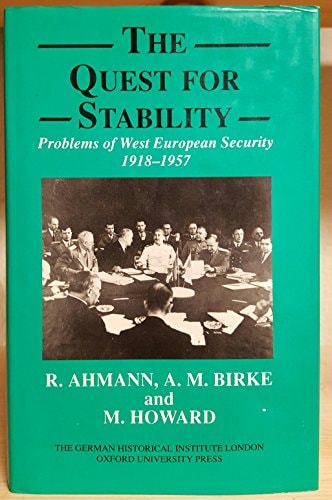
The Quest for Stability: Problems of West European Security 1918-1957
0
0
As an Amazon Associate and affiliate partner, Menrva Books earns from qualifying purchases. Learn more
Author Description
With the end of the Cold War, Europe stands at a crossroad. Today's quest is for a new security order which will provide lasting stability. After the First World War, and again after the Second World War, the Western European states faced a similar problem. Bringing together the work of twenty historians from eight countries, this book examines the security policies developed after each of the two world wars. It asks what ideas shaped them and what difficulties they faced. Continuities and discontinuities are traced and particular attention is paid to the question of how Western Europe achieved a new stability in the 1950s. The contributors deal with foreign policy, political and economic challenges, the impact of new military technologies and strategies, and the aims of the peace movement and the trade unions.
Menrva's Summary
THE THESIS
This volume investigates the historical mechanisms and political frameworks that Western European states employed to establish security and stability in the aftermath of the two World Wars. Edited by A. Birke, Michael S. Howard, and R. Ahmann, this collection synthesizes the research of twenty international historians to analyze the transition from post-war volatility to the relative stability of the 1950s. The authors examine the interplay between foreign policy, economic constraints, and evolving military strategies to determine how security orders were constructed and maintained during these critical periods.
THE SCOPE MAP
What You Will Find
- Comparative analysis of security policies following World War I and World War II.
- Examination of the influence of military technology and strategic doctrine on state policy.
- Assessment of the roles played by non-state actors, including trade unions and peace movements.
- Historical evaluation of the geopolitical factors that facilitated European stability by the 1950s.
THE AUTHORITY PERSPECTIVE
Experts recognize this work as a significant contribution to the study of 20th-century European security architecture. Readers frequently note the academic density of the prose, which provides a comprehensive overview suitable for students and researchers of international relations.
Page Count:
560
Publication Date:
1993-07-29
Publisher:
Oxford University Press
ISBN-10:
0199205035
ISBN-13:
9780199205035
History
Military History
National security
International relations
European History
Community Tags
Similar Books