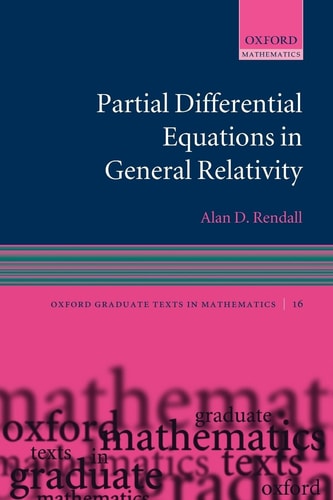
Partial Differential Equations in General Relativity
0
0
As an Amazon Associate and affiliate partner, Menrva Books earns from qualifying purchases. Learn more
Author Description
A graduate level text on a subject which brings together several areas of mathematics and physics: partial differential equations, differential geometry and general relativity. It explains the basics of the theory of partial differential equations in a form accessible to physicists and the basics of general relativity in a form accessible to mathematicians. In recent years the theory of partial differential equations has come to play an ever more important role in research on general relativity. This is partly due to the growth of the field of numerical relativity, stimulated in turn by work on gravitational wave detection, but also due to an increased interest in general relativity among pure mathematicians working in the areas of partial differential equations and Riemannian geometry, who have realized the exceptional richness of the interactions between geometry and analysis which arise. This book provides the background for those wishing to learn about these topics. It treats key themes in general relativity including matter models and symmetry classes and gives an introduction to relevant aspects of the most important classes of partial differential equations, including ordinary differential equations, and material on functional analysis. These elements are brought together to discuss a variety of important examples in the field of mathematical relativity, including asymptotically flat spacetimes, which are used to describe isolated systems, and spatially compact spacetimes, which are of importance in cosmology.
Menrva's Summary
THE THESIS
This text investigates the intersection of partial differential equations, differential geometry, and general relativity to provide a unified mathematical framework for analyzing gravitational phenomena. The author, Alan Rendall, leverages his expertise to bridge the gap between pure mathematics and theoretical physics, presenting complex analytical tools in a manner accessible to researchers in both fields. By synthesizing functional analysis with the geometric requirements of spacetime, the book establishes a rigorous foundation for studying the evolution of gravitational systems.
THE SCOPE MAP
What You Will Find
- Mathematical foundations of partial differential equations and functional analysis.
- Geometric principles of general relativity tailored for mathematicians.
- Analysis of matter models and symmetry classes within spacetime.
- Examination of asymptotically flat and spatially compact spacetimes.
THE AUTHORITY PERSPECTIVE
Experts identify this work as a foundational resource for graduate students and researchers navigating the technical overlap between analysis and relativity. Readers frequently note the high level of mathematical rigor required to engage with the text effectively.
Page Count:
352
Publication Date:
2008-06-09
Publisher:
Oxford University Press
ISBN-10:
0199215413
ISBN-13:
9780199215416
General Relativity
Mathematics
Differential Geometry
Academic
Physics
Relativity
Community Tags
Similar Books