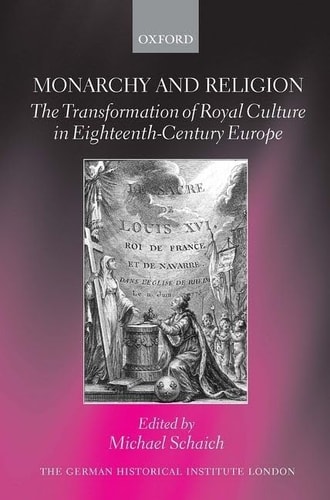
Monarchy and Religion: The Transformation of Royal Culture in Eighteenth-Century Europe
0
0
As an Amazon Associate and affiliate partner, Menrva Books earns from qualifying purchases. Learn more
Author Description
This collection of essays is a pioneering survey of the spiritual dimensions of kingship in eighteenth-century Europe. It investigates the role of clergymen in the mechanics of the court, the religious observances of monarchs and their entourages, and the importance of religious images and ceremonial in underpinning royal power. The volume compares the British, French, Russian, and some of the German monarchies in order to allow comparisons to be drawn between different national and especially confessional settings. Based on original research and new source material, the fifteen essays by established scholars chart mostly unknown territory. Previous research on the subject has focused on the sixteenth and seventeenth centuries at the expense of the age of Enlightenment which has widely been regarded as a period of desacralization of monarchy. The essays open up new perspectives on the function of court clerics, conspicuous and internalized forms of aulic devotion, the gendered framing of religion, the purpose of court ritual, and the divide between the public and private spheres of monarchy. Overall the essays maintain that despite the gradual decline of monarchy by divine right, religion still permeated almost all aspects of court life and monarchical representation. The volume thus challenges received wisdom about the disenchantment of kingship and the rise of more rationalized forms of absolutist government during the period between c.1688 and 1789.
Menrva's Summary
THE THESIS
This collection of essays investigates the extent to which religious belief and practice continued to define royal authority and court culture in eighteenth-century Europe, challenging the traditional narrative of secularization during the Enlightenment. Michael Schaich, a scholar associated with the German Historical Institute, compiles research from fifteen experts to examine the intersection of spiritual life and political power. The volume utilizes original research and primary source material to analyze how monarchs across Britain, France, Russia, and Germany navigated the tension between traditional divine right and emerging rationalist governance. By focusing on the period between 1688 and 1789, the contributors argue that religion remained a central, rather than peripheral, component of monarchical representation.
THE SCOPE MAP
What You Will Find
- Comparative analysis of British, French, Russian, and German monarchies.
- Examination of the role and influence of court clergymen within royal administration.
- Investigation into the gendered dimensions of religious practice and court devotion.
- Analysis of the divide between public ritual and private piety in royal life.
- Evaluation of religious imagery and ceremonial as tools for maintaining political legitimacy.
THE AUTHORITY PERSPECTIVE
Experts recognize this volume as a significant contribution to the study of early modern political culture, particularly for its focus on the often-overlooked eighteenth century. Readers frequently note the academic density of the prose and the rigorous comparative methodology employed by the contributors.
Page Count:
464
Publication Date:
2007-04-19
Publisher:
OUP/German Historical Institute London
ISBN-10:
0199214727
ISBN-13:
9780199214723
Religion
History
Eighteenth Century
European History
Monarchy
Community Tags
Similar Books