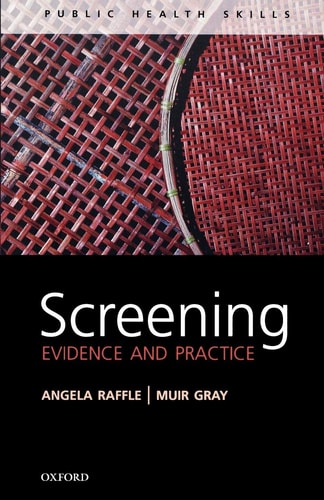
Screening: Evidence and Practice
0
0
As an Amazon Associate and affiliate partner, Menrva Books earns from qualifying purchases. Learn more
Author Description
Screening is the routine testing of populations to identify individuals who may have a particular medical condition or disease. It is carried out by both government and private organisations with the aims of: better prognosis/outcome for individuals; to protect society from contagious disease; to allow rational allocation of resources; to allow selection of healthy individuals; and for research purposes. About £500 million is spent on screening each year in Britain alone, and it is an issue that has relevance in health systems and for the general public and media.For many years, screening was practised without debate, but in the 1960s serious challenges were raised about standard screening procedures. Benefits of screening must be judged against negative side-effects, and concern was raised about potential and actual harm arising when people without a health problem received dangerous and unnecessary investigations and treatments as a result of 'routine' screening tests. Controversy raged and only now 50 years later, is there widespread recognition that quality assured service delivery and proper consumer information are essential. In addition to debate over health risks, the cost-effectiveness of such results also has to be considered, making this a highly contested issue.This book serves as a non-technical, introductory guide to all aspects of screening. The first section deals with concepts, methodology and evidence, explaining what screening is and how to evaluate it. The second section describes practical management, for example how to make policy and how to deliver it to a high quality. It includes many examples and case histories, a glossary to make medical terms accessible to the non-medic, and each chapter concludes with a summary and self-test questions. Although reference is made to the UK NHS, a world leader in screening, the book remains internationally relevant as the principles, knowledge and skills of screening are applicable in any setting. The controversies, paradoxes, uncertainties and ethical dilemmas of screening are explained in a balanced way. Muir Gray and Angela Raffle have been at the forefront of achieving improvements in screening over recent years, and they bring their wealth of experience to this essential text.
Menrva's Summary
THE THESIS
This book investigates the complex balance between the clinical benefits of population-wide screening and the potential for harm, cost-inefficiency, and ethical dilemmas inherent in routine medical testing. Authors Angela E. Raffle and J. A. Muir Gray, both experts in public health and screening policy, utilize their extensive experience within the UK National Health Service to construct a framework for evaluating screening programs. They argue that effective screening requires rigorous quality assurance, transparent consumer information, and a clear understanding of the trade-offs between early detection and unnecessary medical intervention.
THE SCOPE MAP
What You Will Find
- Methodological foundations for evaluating the efficacy and evidence base of screening programs.
- Practical management strategies for policy development and high-quality service delivery.
- Case histories illustrating the real-world application and challenges of screening initiatives.
- A comprehensive glossary and self-test questions designed to make complex medical concepts accessible to non-specialists.
THE AUTHORITY PERSPECTIVE
Experts and public health professionals recognize this work as a foundational text for understanding the operational and ethical complexities of screening. Readers frequently note that the prose remains accessible to non-medics while providing the analytical rigor necessary for policy makers and health administrators.
Page Count:
334
Publication Date:
2007-10-04
Publisher:
Oxford University Press
ISBN-10:
0199214492
ISBN-13:
9780199214495
Epidemiology
Medicine
Health Policy
Medical policy
Public Health
Medical Ethics
Community Tags
Similar Books










Reader Comments
Share Your Thoughts
No comments yet. Be the first to share your thoughts!