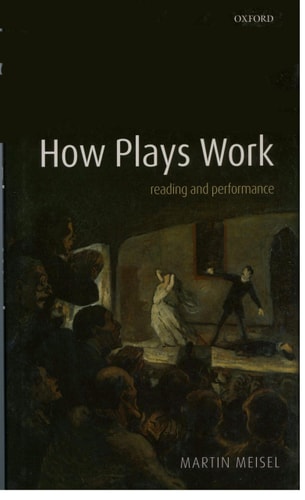
How Plays Work: Reading and Performance
0
0
As an Amazon Associate and affiliate partner, Menrva Books earns from qualifying purchases. Learn more
Author Description
Why are readers who are generally at home with narrative and discursive prose, and even readily responsive to poetry, far less confident and intuitive when it comes to plays? The complication lies in the twofold character of the play as it exists on the page - as a script or score to be realized, and as literature. Martin Meisel's engaging account of how we read play plays on the page shows that the path to the fullest imaginative response is an understanding of how plays work. What is entailed is something like learning a language - vocabulary, grammar, syntax - but learning also how the language operates in those concrete situations where it is deployed.Meisel begins with a look at matters often taken for granted in coding and convention, and then - under 'Beginnings' - at what is entailed in establishing and entering the invented world of the play. Each succeeding chapter is a gesture at enlarging the scope: 'Seeing and Hearing', 'The Uses of Place', 'The Role of the Audience', 'The Shape of the Action', and 'The Action of Words'. The final chapters, 'Reading Meanings' and 'Primal Attractions', explore ways in which both the drive for significant understanding and the appetite for wonder can and do find satisfaction and delight.Cultivated in tone and jargon-free, How Plays Work is illuminated by dozens of judiciously chosen examples from western drama - from classical Greek dramatists to contemporary playwrights, both canonical and relatively obscure. It will appeal as much to the serious student of the theatre as to the playgoer who likes to read a play before seeing it performed.
Menrva's Summary
THE THESIS
This book investigates the fundamental disconnect between how readers approach narrative prose and how they engage with the unique, dual-natured medium of dramatic scripts. Martin Meisel, a scholar of dramatic literature, argues that the difficulty in reading plays stems from a lack of familiarity with the specific conventions of the stage. He provides a structured framework for understanding the mechanics of drama, treating the script as a score that requires a specialized vocabulary and syntax to be fully realized in the reader's imagination.
THE SCOPE MAP
What You Will Find
- A comprehensive breakdown of dramatic conventions including stage directions, dialogue, and character interaction.
- Analytical tools for interpreting the use of space, time, and audience engagement in theatrical works.
- A wide-ranging selection of examples spanning from classical Greek drama to modern contemporary playwrights.
- Methodologies for decoding the subtext and thematic depth inherent in the action of words.
THE AUTHORITY PERSPECTIVE
Experts and students of the theater frequently cite this work as a foundational text for bridging the gap between the written script and the performed play. Readers appreciate the accessible, jargon-free prose that makes complex dramaturgical concepts clear for both academic study and casual playgoing.
Page Count:
300
Publication Date:
2007-08-23
Publisher:
Oxford University Press
ISBN-10:
0199215499
ISBN-13:
9780199215492
Drama
Theater
Literary Criticism
Education
Drama
Community Tags
Similar Books