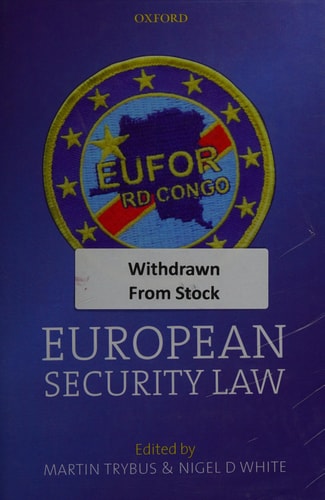
European Security Law
0
0
As an Amazon Associate and affiliate partner, Menrva Books earns from qualifying purchases. Learn more
Author Description
There have been a number of EU military operations in the last few years, evidence of a growing European military confidence, which in turn is a reflection of a developing competence in security matters. The creation of the European Union and its Common Foreign and Security Policy by the Maastricht Treaty of 1992 heralded this development, though the idea of a common defense can be traced to the beginnings of European integration. This book provides an analysis of the EU's evolving legal framework and powers on such matters, but it also recognizes that such a framework sits, sometimes uneasily, within the wider body of EU and International Law. The EU's security and defense policy also overlaps with those of other organizations such as the Organization for Security and Cooperation in Europe (OSCE), but more especially the North Atlantic Treaty Organization (NATO). EU relations with NATO have, in particular, caused some concern and are still evolving as both organizations seek to play a wider security role in the post-Cold War, and now post-9/11, era. With security now dominating political agendas at the domestic, regional and international levels, it is no surprise that the EU's concern for security has grown, and, following the Union's respect for the rule of law, has been shaped legally as well as politically. This book evaluates the progress of the Union in this regard in its international context and in its wider context of European integration generally. The analysis is in the main a legal one, but is placed squarely within wider historical and political perspectives.
Menrva's Summary
THE THESIS
This book investigates the legal framework and evolving competencies of the European Union regarding security and defense policy within the broader context of international law. The authors, Martin Trybus and Nigel D. White, utilize a combination of legal analysis, historical context, and political theory to examine how the EU navigates its security responsibilities. They argue that the Union's security architecture is not an isolated development but one that must reconcile its internal legal mandates with the external influence of organizations like NATO and the OSCE. By tracing the evolution from the Maastricht Treaty to the post-9/11 era, the text provides a comprehensive evaluation of how the EU balances political ambition with the rule of law.
THE SCOPE MAP
What You Will Find
- Analysis of the legal evolution of the Common Foreign and Security Policy since the 1992 Maastricht Treaty.
- Examination of the jurisdictional overlaps between the European Union, NATO, and the OSCE.
- Assessment of the legal constraints and powers governing EU military operations.
- Integration of historical, political, and legal perspectives on European security cooperation.
THE AUTHORITY PERSPECTIVE
Experts recognize this work as a foundational legal analysis for understanding the institutional complexities of European defense policy. Readers frequently note the academic density of the prose, which makes it a primary resource for scholars and practitioners in the field of international law.
Page Count:
400
Publication Date:
2007-05-17
Publisher:
Oxford University Press
ISBN-10:
0199218625
ISBN-13:
9780199218622
Military Law
Military History
International relations
Law
European Union
Community Tags
Similar Books