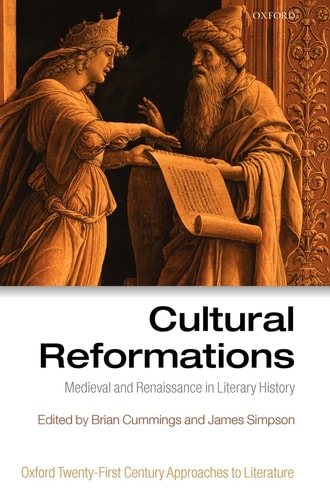
Cultural Reformations: Medieval and Renaissance in Literary History
0
0
As an Amazon Associate and affiliate partner, Menrva Books earns from qualifying purchases. Learn more
Author Description
The original essays in Oxford Twenty-First Century Approaches to Literature mean to provoke rather than reassure, to challenge rather than codify. Instead of summarizing existing knowledge scholars working in the field aim at opening fresh discussion. Instead of emphasizing settled consensus they direct their readers to areas of enlivened and unresolved debate.The deepest periodic division in English literary history has been between the medieval and the early modern, not least because the cultural investments in maintaining that division are exceptionally powerful. Narratives of national and religious identity and freedom, of individual liberties, of the history of education and scholarship, of reading or the history of the book, of the very possibility of persuasive historical consciousness itself: each of these narratives (and more) is motivated by positing a powerful break around 1500.None of the claims for a profound historical and cultural break at the turn of the fifteenth into the sixteenth centuries is negligible. The very habit of working within those periodic bounds (either medieval or early modern) tends, however, simultaneously to affirm and to ignore the rupture. It affirms the rupture by staying within standard periodic bounds, but it ignores it by never examining the rupture itself. The moment of profound change is either, for medievalists, just over an unexplored horizon; or, for early modernists, a zero point behind which more penetrating examination is unnecessary. That situation is now rapidly changing. Scholars are building bridges that link previously insular areas. Both periods are starting to look different in dialogue with each other.The change underway has yet to find collected voices behind it. Cultural Reformations volume aims to provide those voices. It will give focus, authority, and drive to a new area.
Menrva's Summary
THE THESIS
This volume investigates the validity of the traditional historical divide between the medieval and early modern periods in English literary history. Editors Brian B. Cummings and James Simpson assemble a collection of original essays that challenge the long-standing academic habit of treating the year 1500 as a definitive rupture. By questioning the cultural and political investments that maintain this periodic boundary, the contributors argue for a more integrated approach to literary scholarship that bridges the gap between these two traditionally insular fields.
THE SCOPE MAP
What You Will Find
- Critical analysis of the historiographical construction of the medieval and early modern divide.
- Interdisciplinary perspectives on national, religious, and educational identity formation.
- Examination of the history of the book and the evolution of historical consciousness.
- Collaborative scholarship aimed at fostering dialogue between medievalists and early modernists.
THE AUTHORITY PERSPECTIVE
Scholars identify this text as a significant intervention in periodization studies, noting its success in challenging entrenched academic boundaries. The prose is dense and intended for an audience of advanced students and researchers in literary history.
Page Count:
540
Publication Date:
2010-08-20
Publisher:
Oxford University Press
ISBN-10:
0199212481
ISBN-13:
9780199212484
History
Literary Criticism
Academic
Community Tags
Other Editions(2)
Similar Books

Reader Comments
Share Your Thoughts
No comments yet. Be the first to share your thoughts!