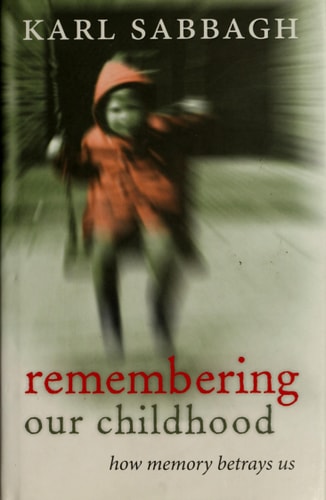
Remembering Our Childhood: How Memory Betrays Us
0
0
As an Amazon Associate and affiliate partner, Menrva Books earns from qualifying purchases. Learn more
Author Description
How reliable is memory? For most of us, accurately remembering the details of a novel we read six months ago, or a conversation we had last week, is a difficult task. How much more daunting, then, to recall events from early childhood? This is not an academic question. The alarming rise, over the past two decades, in criminal convictions for child abuse based on "recovered" memories makes clear the need for a solid, scientifically based understanding of the nature and trustworthiness of childhood memories.In this fascinating and often disturbing book, Karl Sabbagh looks at psychologists' present understanding of how memory works--and fails to work--particularly in terms of childhood recollections. He shows that, in cases of "recovered memories," the unreliability of memory has had tragic consequences. Many people firmly believe that they can recall scenes from their infancy. But what does science tell us about the childhood memory? Through closely examining memories culled from his interviews, as well as psychologists' and neuroscientists' studies of memory, it becomes clear that, whatever individuals might claim, memories of the first two years of our lives are simply not accessible to us. Even later memories are fragile, yielding to suggestion and our desire for neat stories. Sabbagh goes on to examine real cases where causal remarks by children in nurseries, memories "recovered" in therapy, wild claims of satanic rituals, animal sacrifices, and grisly infant murders, have produced wrongful arrests and destroyed careers and families.Drawing on extensive research, including transcribed interviews presented at court, Remembering Our Childhood presents a scientific understanding of memory and a compelling argument for the critical role of scientific evidence in cases involving the memory of witnesses.
Menrva's Summary
THE THESIS
This book investigates the scientific validity of recovered childhood memories and the profound, often destructive, consequences of relying on them in legal and therapeutic contexts. Karl Sabbagh, a seasoned science writer, synthesizes research from psychology and neuroscience to challenge the common belief that early childhood memories are reliable archives of the past. By examining the mechanics of memory formation and the susceptibility of the human mind to suggestion, he argues that the legal system must prioritize empirical evidence over subjective, potentially fabricated recollections.
THE SCOPE MAP
What You Will Find
- Analysis of the biological and psychological limitations of memory during infancy and early childhood.
- Examination of high-profile legal cases involving recovered memories of abuse and ritualistic crimes.
- Synthesis of neuroscientific studies regarding how the brain stores and retrieves information.
- Evaluation of the role of suggestion and narrative bias in the creation of false memories.
THE AUTHORITY PERSPECTIVE
Experts and readers recognize this work as a critical examination of the intersection between cognitive science and the judicial system. The text is noted for its accessible yet rigorous approach to complex psychological phenomena, serving as a cautionary analysis for professionals and laypeople alike.
Page Count:
224
Publication Date:
2009-03-22
Publisher:
Oxford University Press
ISBN-10:
0199218404
ISBN-13:
9780199218400
Psychology
Science
Non-Fiction
True Crime
Memory
Sociology
Recovered memory
Community Tags
Other Editions(2)

Similar Books






Reader Comments
Share Your Thoughts
No comments yet. Be the first to share your thoughts!