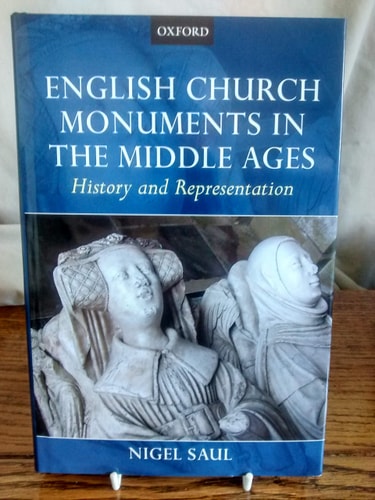
English Church Monuments in the Middle Ages: History and Representation
0
0
As an Amazon Associate and affiliate partner, Menrva Books earns from qualifying purchases. Learn more
Author Description
English Church Monuments in the Middle Ages offers a comprehensive survey of English church monuments from the pre-Conquest period to the early sixteenth century. Ground-breaking in its treatment of the subject in an historical context, it explores medieval monuments both in terms of their social meaning and the role that they played in the religious strategies of the commemorated.Attention is given to the production of monuments, the pattern of their geographical distribution, the evolution of monument types, and the role of design in communicating the monument's message. A major theme is the self-representation of the commemorated as reflected in the main classes of effigy-those of the clergy, the knights and esquires, and the lesser landowner or burgess class, while the effigial monuments of women are examined from the perspective of the construction of gender.While seeking to use monuments as windows onto the experiences and lives of the commemorated, it also exploits documentary sources to show what they can tell us about the influences that helped shape the monuments. An innovative chapter looks at the construction of identity in inscriptions, showing how the liturgical role of the monument limited the opportunities for expressions of self. Nigel Saul seeks to place monuments at the very centre of medieval studies, highlighting their importance not only for the history of sculpture and design, but also for social and religious history more generally.
Menrva's Summary
THE THESIS
This work investigates how medieval English church monuments functioned as both artistic expressions and social instruments for the commemoration of the deceased. Nigel Saul, a distinguished historian of the Middle Ages, synthesizes archaeological evidence with documentary sources to argue that these monuments were central to the religious and social strategies of their time. By examining the evolution of effigies and inscriptions, the author provides a framework for understanding how medieval individuals constructed their identities and communicated their status to both the living and the divine.
THE SCOPE MAP
What You Will Find
- A chronological survey of English church monuments from the pre-Conquest period through the early sixteenth century.
- Analysis of monument production, geographical distribution, and the evolution of specific design types.
- Examination of social classes including clergy, knights, esquires, and the burgess class.
- Investigation into the construction of gender through the study of female effigial monuments.
- A study of the role of inscriptions and liturgical context in shaping personal identity.
THE AUTHORITY PERSPECTIVE
Scholars and historians frequently cite this text as a foundational resource for understanding the intersection of material culture and social history in medieval England. Readers often note the academic rigor and the depth of the author's analysis regarding the symbolic function of funerary art.
Page Count:
400
Publication Date:
2009-04-15
Publisher:
Oxford University Press
ISBN-10:
0199215987
ISBN-13:
9780199215980
Architecture
Religion
History
Art And Society
Art History
Art British
Community Tags
Similar Books