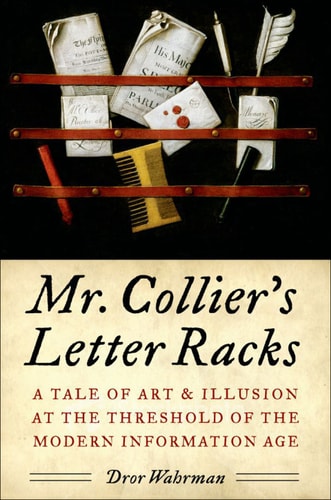
Mr. Collier's Letter Racks: A Tale of Art and Illusion at the Threshold of the Modern Information Age
0
0
As an Amazon Associate and affiliate partner, Menrva Books earns from qualifying purchases. Learn more
Author Description
Three hundred years ago, an unprecedented explosion in inexpensive, disposable print--newspapers, pamphlets, informational publications, artistic prints--ushered in a media revolution that forever changed our relationship to information. One unusually perceptive man, an obscure Dutch/British still life painter named Edward Collier, understood the full significance of these momentous changes and embedded in his work secret warnings about the inescapable slippages between author and print, meaning and text, viewer and canvas, perception and reality. Working around 1700, Collier has been neglected, even forgotten, precisely because his secret messages have never been noticed, let alone understood. Until now. In Mr. Collier's Letter Racks, Dror Wahrman recovers the tale of an extraordinary illusionist artist who engaged in a wholly original way with a major transformation of his generation. Wahrman shows how Collier developed a hidden language within his illusionist paintings--replete with minutely coded messages, witty games, intricate allusions, and private jokes--to draw attention to the potential and the pitfalls of this new information age. A remarkably shrewd and prescient commentator on the changes unfolding around him, not least the advent of a new kind of politics following the Glorious Revolution, Collier performed a post-modernist critique of modernity long before the modern age. His trompe l'oeil paintings are filled with seemingly disconnected, enigmatic objects--letters, seals, texts of speeches, magnifying glasses, title pages--and with teasingly significant details that require the viewer to lean in and peer closely. Wahrman does just that, taking on the role of detective/cultural historian to unravel the layers of deceptions contained within Collier's extraordinary paintings. Written with passionate enthusiasm and including more than 70 color illustrations, Mr. Collier's Letter Racks is a spell-binding feat of cultural history, illuminating not only the
Menrva's Summary
THE THESIS
How did the 17th-century painter Edward Collier use the art of trompe l'oeil to critique the burgeoning information revolution of his time? Dror Wahrman, a cultural historian, investigates the life and work of this obscure Dutch/British artist to reveal a sophisticated system of hidden messages embedded within his still life paintings. By analyzing the interplay between print culture and visual art, Wahrman argues that Collier acted as a prescient commentator on the shifting relationship between reality, perception, and the mass dissemination of information during the post-Glorious Revolution era.
THE SCOPE MAP
What You Will Find
- An analysis of the 17th-century media revolution, including the rise of newspapers and pamphlets.
- A detailed examination of Edward Collier's trompe l'oeil painting techniques and their symbolic functions.
- Historical context regarding the political and social climate of Britain and the Netherlands around 1700.
- A methodology for decoding visual metaphors, including letters, seals, and magnifying glasses, within historical art.
THE AUTHORITY PERSPECTIVE
Experts and historians recognize this work as a significant contribution to the study of visual culture and the history of information. Readers frequently note the meticulous detail Wahrman applies to his detective-like analysis of Collier's paintings, making it a valuable resource for those interested in the intersection of art history and media studies.
Page Count:
288
Publication Date:
2012-01-01
Publisher:
Oxford University Press
ISBN-10:
0199910960
ISBN-13:
9780199910960
Non-Fiction
History
Biography
Art And Society
European History
Art History
Art Criticism
Humanities
Painting Dutch
Cultural History
Community Tags
Similar Books

Reader Comments
Share Your Thoughts
No comments yet. Be the first to share your thoughts!