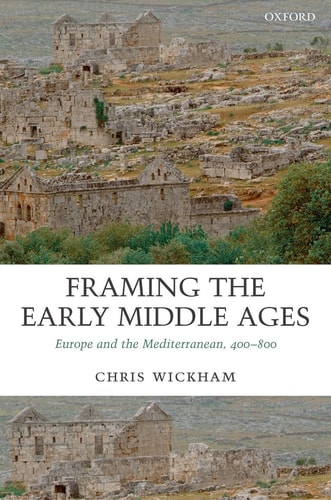
Framing the Early Middle Ages: Europe and the Mediterranean, 400-800
0
0
As an Amazon Associate and affiliate partner, Menrva Books earns from qualifying purchases. Learn more
Author Description
The Roman empire tends to be seen as a whole whereas the early middle ages tends to be seen as a collection of regional histories, roughly corresponding to the land-areas of modern nation states. As a result, early medieval history is much more fragmented, and there have been few convincing syntheses of socio-economic change in the post-Roman world since the 1930s. In recent decades, the rise of early medieval archaeology has also transformed our source-base, but this has not been adequately integrated into analyses of documentary history in almost any country.In Framing the Early Middle Ages Chris Wickham aims at integrating documentary and archaeological evidence together, and also, above all, at creating a comparative history of the period 400-800, by means of systematic comparative analyses of each of the regions of the latest Roman and immediately post-Roman world, from Denmark to Egypt (only the Slav areas are left out). The book concentrates on classic socio-economic themes, state finance, the wealth and identity of the aristocracy, estate management, peasant society, rural settlement, cities, and exchange. These are only a partial picture of the period, but they are intended as a framing for other developments, without which those other developments cannot be properly understood.Wickham argues that only a complex comparative analysis can act as the basis for a wider synthesis. Whilst earlier syntheses have taken the development of a single region as 'typical', with divergent developments presented as exceptions, this book takes all different developments as typical, and aims to construct a synthesis based on a better understanding of difference and the reasons for it. This is the most ambitious and original survey of the period ever written.
Menrva's Summary
THE THESIS
This work investigates the socio-economic transformation of Europe and the Mediterranean between 400 and 800 by challenging the fragmented, nation-state-centric approach to early medieval history. Chris Wickham, a prominent historian, synthesizes documentary evidence with contemporary archaeological findings to construct a comparative framework. He argues that previous historical models failed by treating single regions as typical, and instead proposes that a complex, comparative analysis of diverse regional developments is necessary to understand the post-Roman world.
THE SCOPE MAP
What You Will Find
- Comparative analysis of regional socio-economic structures from Denmark to Egypt.
- Integration of archaeological data with traditional documentary history.
- Examination of state finance, aristocratic wealth, estate management, and peasant society.
- Analysis of rural settlement patterns, urban development, and exchange systems.
THE AUTHORITY PERSPECTIVE
Experts recognize this text as a foundational and highly ambitious synthesis that bridges the gap between archaeology and traditional history. Readers frequently note the academic density of the prose, which serves as a rigorous reference for scholars and advanced students of the period.
Page Count:
1024
Publication Date:
2007-02-08
Publisher:
Oxford University Press
ISBN-10:
0199212961
ISBN-13:
9780199212965
History
Archaeology
Middle Ages
European History
Community Tags
Similar Books