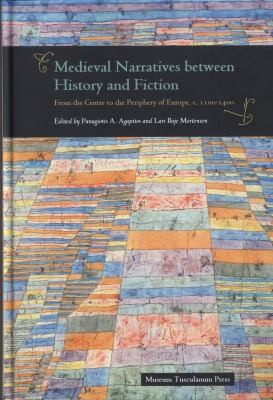
Medieval Narratives Between History And Fiction From The Centre To The Periphery Of Europe C. 1100-1400
0
0
As an Amazon Associate and affiliate partner, Menrva Books earns from qualifying purchases. Learn more
Author Description
The rise of literary fiction in medieval Europe has been a hotly debated topic among scholars for at least two decades, but until now that debate has come with severe limitations, focusing on ‘modern’ French and German romances of the twelfth and thirteenth centuries. Attempting to find common ground among scholars from various disciplines and regions, Medieval Narratives between History and Fiction seeks to clarify the subject by including a wide range of medieval narratives irrespective of their modern label and affiliation to certain disciplines. The chapters collected here broaden the discussion by moving beyond the canonical French and German romances, focusing mainly on texts in Greek, Latin and Old Norse (and also some in Serbian), and by opting for a ‘peripheral’ and a long-term view of the subject. The chapters take us from Graeco-Roman antiquity to medieval France, then to the Scandinavian lands and from there to south-eastern Europe and Byzantium as the link back to the Graeco-Roman world. This disposition also follows a spiral motion in time, leading us from antiquity to late antiquity and from the eleventh to the fifteenth century. By expanding the linguistic as well as the geographical and chronological scope of the debate, the book shows that we should not think of a ‘rise of fiction’ per se; rather, we should see fiction as a potential always imbued in and related to historical narratives – and recognize that non-fictional and non-vernacular writing are important for a modern understanding of medieval fiction.
Menrva's Summary
THE THESIS
This book investigates the complex relationship between history and fiction in medieval European narratives, challenging traditional scholarly limitations. It expands the scope of the debate beyond canonical French and German romances to include a wide range of narratives from antiquity to the 15th century, utilizing texts in Greek, Latin, Old Norse, and Serbian. By adopting a peripheral and long-term view, the collection demonstrates that fiction was not a separate 'rise' but rather a potential inherent within historical narratives, emphasizing the significance of non-fictional and non-vernacular writing for understanding medieval fiction.
THE SCOPE MAP
- Analysis of medieval narratives from the center to the periphery of Europe.
- Inclusion of texts in Greek, Latin, Old Norse, and Serbian.
- Chronological scope from Graeco-Roman antiquity to the 15th century.
- Exploration of the 'peripheral' perspective in literary studies.
- Re-evaluation of the 'rise of literary fiction' debate.
- Focus on the interplay between historical and fictional elements in narratives.
- Significance of non-fictional and non-vernacular writing in understanding medieval fiction.
THE AUTHORITY PERSPECTIVE
This collection aims to bridge disciplinary and regional divides among scholars studying medieval literature. By broadening the geographical, linguistic, and chronological scope, it challenges the narrow focus on 12th and 13th-century French and German romances that has characterized previous debates. The book's approach suggests a more nuanced understanding of fiction as an intrinsic potential within historical narratives rather than a distinct literary development. It highlights the importance of considering a wider array of texts and traditions to grasp the full picture of medieval narrative practices.
Page Count:
389
Publication Date:
2012-01-01
ISBN-10:
8763538091
ISBN-13:
9788763538091
History
Non-Fiction
European History
Literary History
Literary Criticism
Community Tags
Similar Books