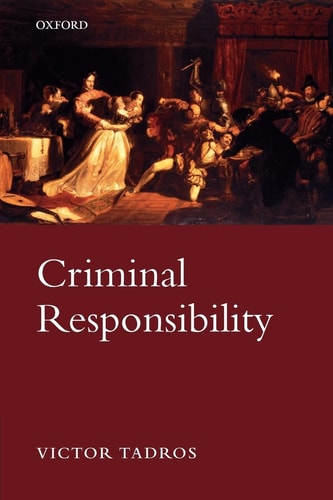
Criminal Responsibility
0
0
As an Amazon Associate and affiliate partner, Menrva Books earns from qualifying purchases. Learn more
Author Description
This book considers the proper nature and scope of criminal responsibility in the light of its institutional and political role. Tadros begins by providing an account of the foundations, both ethical and political, of criminal responsibility, and moves on to reconsider some of the central doctrines of criminal responsibility.Part 1 examines the nature of criminal responsibility by employing a distinctive new conception of autonomy. Tadros explores the nature of autonomy, and asks what it means to respect autonomy. Building upon this consideration of autonomy, Tadros then explores the central conditions of responsibility. He provides the first systematic consideration of the relationship between criminal responsibility and liberal political theory, showing how the conditions of responsibility are articulated in, and restrained by, the institutional setting of the criminal law.In Part 2, Tadros moves on to consider some of the central doctrines of criminal responsibility. He examines the proper nature and role of causation, intentions, and beliefs; asking whether these concepts should be understood as descriptive or normative. The book moves on to provide a systematic normative investigation of the nature and role of criminal omissions and criminal defenses. Included are: a thorough account of the different ways in which mental disorders might ground defenses, the nature of justification defenses, the different kinds of excuse claim and the role that particular characteristics of the accused might have on the standards which the defendant must have met to escape criminal responsibility.
Menrva's Summary
THE THESIS
This book investigates the ethical and political foundations of criminal responsibility to determine how these concepts function within the institutional framework of the criminal justice system. Victor Tadros, a scholar of legal theory, utilizes a normative approach to analyze how autonomy serves as the basis for legal accountability. By bridging liberal political theory with criminal doctrine, the author argues that the conditions of responsibility are inherently shaped and constrained by the political role of the state.
THE SCOPE MAP
What You Will Find
- A systematic analysis of the relationship between criminal responsibility and liberal political theory.
- A re-evaluation of central legal doctrines including causation, intention, and belief systems.
- An examination of criminal omissions and the normative role of criminal defenses.
- A detailed exploration of how mental disorders and individual characteristics influence excuse claims.
THE AUTHORITY PERSPECTIVE
Legal scholars and practitioners frequently cite this work as a rigorous contribution to the philosophy of criminal law. Experts highlight the text's academic density and its systematic approach to reconciling normative theory with practical legal doctrine.
Page Count:
350
Publication Date:
2007-05-17
Publisher:
Oxford University Press
ISBN-10:
0199225826
ISBN-13:
9780199225828
Philosophy
Law
Criminal Law
Legal Theory