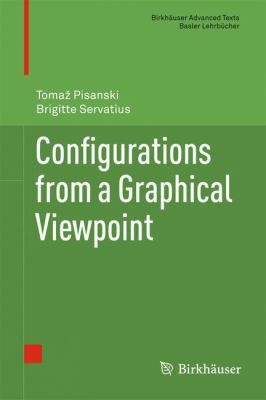
Configurations From A Graphical Viewpoint
0
0
As an Amazon Associate and affiliate partner, Menrva Books earns from qualifying purchases. Learn more
Author Description
Configurations can be studied from a graph-theoretical viewpoint via the so-called Levi graphs and lie at the heart of graphs, groups, surfaces, and geometries, all of which are very active areas of mathematical exploration. In this self-contained textbook, algebraic graph theory is used to introduce groups; topological graph theory is used to explore surfaces; and geometric graph theory is implemented to analyze incidence geometries. After a preview of configurations in Chapter 1, a concise introduction to graph theory is presented in Chapter 2, followed by a geometric introduction to groups in Chapter 3. Maps and surfaces are combinatorially treated in Chapter 4. Chapter 5 introduces the concept of incidence structure through vertex colored graphs, and the combinatorial aspects of classical configurations are studied. Geometric aspects, some historical remarks, references, and applications of classical configurations appear in the last chapter. With over two hundred illustrations, challenging exercises at the end of each chapter, a comprehensive bibliography, and a set of open problems, Configurations from a Graphical Viewpoint is well suited for a graduate graph theory course, an advanced undergraduate seminar, or a self-contained reference for mathematicians and researchers.
Menrva's Summary
THE THESIS
This textbook explores the mathematical concept of configurations through the lens of graph theory. The book introduces algebraic graph theory to explain groups, topological graph theory for surfaces, and geometric graph theory for incidence geometries. It is structured to guide readers from basic graph theory and group introductions to combinatorial maps, surfaces, and incidence structures, culminating in a study of classical configurations. The text is designed for graduate graph theory courses, advanced undergraduate seminars, or as a reference for mathematicians and researchers.
THE SCOPE MAP
- Introduction to configurations via Levi graphs.
- Concise introduction to graph theory.
- Geometric introduction to groups.
- Combinatorial treatment of maps and surfaces.
- Incidence structures through vertex-colored graphs.
- Combinatorial and geometric aspects of classical configurations.
- Historical remarks, references, and applications.
- Over two hundred illustrations and challenging exercises.
THE AUTHORITY PERSPECTIVE
The book is presented as a self-contained textbook suitable for graduate and advanced undergraduate students, as well as researchers. Its comprehensive approach, utilizing algebraic, topological, and geometric graph theory, aims to provide a thorough understanding of configurations. The inclusion of over two hundred illustrations, challenging exercises, a comprehensive bibliography, and open problems suggests a resource designed for in-depth study and exploration of the subject matter.
Page Count:
279
Publication Date:
2012-01-01
ISBN-10:
0817683631
ISBN-13:
9780817683634
Science
Non-Fiction
Graph Theory
Geometry
Group Theory
Combinatorics
Topology
Community Tags
Similar Books