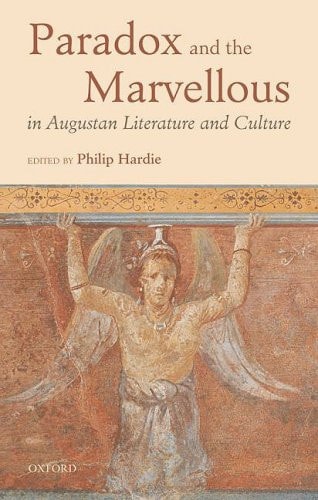
Paradox and the Marvellous in Augustan Literature and Culture
0
0
As an Amazon Associate and affiliate partner, Menrva Books earns from qualifying purchases. Learn more
Author Description
The literature and art of Augustan Rome are often thought of as the product of an age of high classicism, characterized by maturity, balance, and harmony. This volume examines the presence of what might be seen as an unclassical love of paradox and the marvellous, and shows that it is an important strain in the poetry of Virgil, Horace, and Ovid, as well as in prose works of history and rhetoric, and in the Augustan visual arts. The volume includes chapters by some of the leading experts in the Augustan period as well as a number of younger scholars. It will be of interest to all students of Roman literature and culture.
Menrva's Summary
THE THESIS
This volume investigates the tension between the perceived classicism of Augustan Rome and the persistent, often overlooked, presence of the paradoxical and the marvellous in its cultural output. Philip Hardie, a distinguished scholar of Latin literature, compiles a collection of essays that challenge the traditional view of Augustan culture as purely defined by balance and harmony. By analyzing poetry, historical prose, and visual arts, the contributors argue that an appreciation for the extraordinary and the contradictory was a vital, albeit unclassical, component of the era's creative identity.
THE SCOPE MAP
What You Will Find
- Analysis of the works of Virgil, Horace, and Ovid regarding their use of paradox.
- Examination of the marvellous in Roman historical and rhetorical prose.
- Investigation into the visual arts of the Augustan period as a reflection of cultural complexity.
- A multi-disciplinary approach incorporating perspectives from both established experts and emerging scholars.
THE AUTHORITY PERSPECTIVE
Scholars in the field of Roman studies recognize this volume as a significant contribution to the re-evaluation of Augustan aesthetics. The text is noted for its academic rigor and its ability to synthesize diverse artistic and literary mediums into a cohesive argument.
Page Count:
408
Publication Date:
2009-08-03
Publisher:
Oxford University Press
ISBN-10:
0199231249
ISBN-13:
9780199231249
History
Roman History
Art Roman
Art History
Rome
Criticism history
Literary Criticism
Community Tags
Similar Books