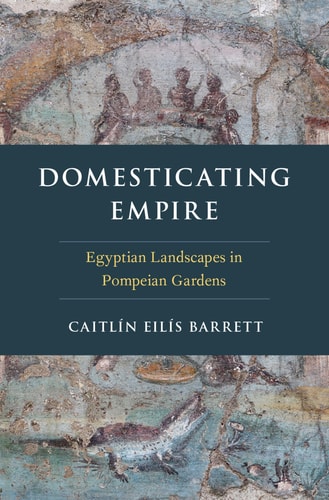
Domesticating Empire: Egyptian Landscapes in Pompeian Gardens
0
0
As an Amazon Associate and affiliate partner, Menrva Books earns from qualifying purchases. Learn more
Author Description
Domesticating Empire' Is The First Contextually-oriented Monograph On Egyptian Imagery In Roman Households. Caitlin Barrett Draws On Case Studies From Flavian Pompeii To Investigate The Close Association Between Representations Of Egypt And A Particular Type Of Roman Household Space: The Domestic Garden. Through Paintings And Mosaics Portraying The Nile, Canals That Turned The Garden Itself Into A Miniature Nilescape, And Statuary Depicting Egyptian Themes, Many Gardens In Pompeii Offered Ancient Visitors Evocations Of A Roman Vision Of Egypt. Simultaneously Faraway And Familiar, These Imagined Landscapes Made The Unfathomable Breadth Of Empire Compatible With The Familiarity Of Home. In Contrast To Older Interpretations That Connect Roman Aegyptiaca To The Worship Of Egyptian Gods Or The Problematic Concept Of Egyptomania, A Contextual Analysis Of These Garden Assemblages Suggests New Possibilities For Meaning. In Pompeian Houses, Egyptian And Egyptian-looking Objects And Images Interacted With Their Settings To Construct Complex Entanglements Of Foreign And Familiar, Self And Other. Representations Of Egyptian Landscapes In Domestic Gardens Enabled Individuals To Present Themselves As Sophisticated Citizens Of Empire. Yet At The Same Time, Household Material Culture Also Exerted An Agency Of Its Own: Domesticizing, Familiarizing, And Romanizing Once-foreign Images And Objects. That Which Was Once Imagined As Alien And Potentially Dangerous Was Now Part Of The Domus Itself, Increasingly Incorporated Into Cultural Constructions Of What It Meant To Be Roman. Featuring Brilliant Illustrations In Both Color And Black And White, Domesticating Empire Reveals The Importance Of Material Culture In Transforming Household Space Into A Microcosm Of Empire. Introduction: Egypt In The Garden -- Imagining The Nile: Affordances And Contexts -- From Egypt To Oikoumene: Interactive Landscapes In The Casa Dell'efebo -- Self, Other, And Beyond In The Casa Del Medico -- Making Meaning
Menrva's Summary
THE THESIS
This book investigates how the presence of Egyptian-themed imagery and landscaping in Pompeian domestic gardens functioned as a mechanism for Roman citizens to negotiate their identity within the broader context of the Roman Empire. Caitlin E. Barrett, an expert in Roman archaeology and material culture, utilizes a contextual analysis of household assemblages to challenge traditional interpretations of 'Egyptomania.' By examining the physical integration of Nile-inspired motifs into private spaces, the author argues that these gardens served as tools for domesticating foreign concepts, thereby reinforcing the status of the homeowner as a sophisticated participant in imperial culture.
THE SCOPE MAP
What You Will Find
- Detailed analysis of Flavian-era Pompeian domestic gardens.
- Examination of paintings, mosaics, and statuary depicting Egyptian themes.
- A framework for understanding the interaction between domestic space and imperial identity.
- Case studies focusing on the Casa dell'Efebo and the Casa del Medico.
Scope Limits
- The study is geographically restricted to Pompeii and does not provide a comprehensive survey of Egyptian influence across the entire Roman Empire.
- The analysis focuses primarily on domestic garden contexts rather than public religious or state-sponsored monuments.
THE AUTHORITY PERSPECTIVE
Scholars and archaeologists recognize this work as a significant contribution to the study of Roman domestic life and the reception of foreign cultures. Readers frequently note the academic rigor of the prose and the author's ability to synthesize complex material evidence into a coherent argument about imperial identity.
Page Count:
0
Publication Date:
1900-01-01
Publisher:
Oxford University Press,
ISBN-10:
019064138X
ISBN-13:
9780190641382
History
Roman History
Rezeption
Gardens
Gartenbau
Architecture and Planning
Horticulture
Imperialismus
Archaeology
Art History
Garten
Jardins
In art
Community Tags
Similar Books