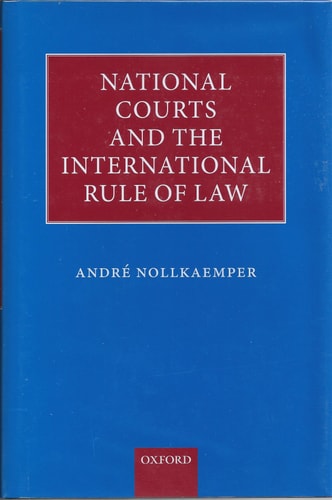
National Courts and the International Rule of Law
0
0
As an Amazon Associate and affiliate partner, Menrva Books earns from qualifying purchases. Learn more
Author Description
This book explores how domestic courts contribute to the maintenance of the rule of international law by providing judicial control over the exercises of public powers that may conflict with international law. The main focus of the book will be on judicial control of exercise of public powers by states. Key cases that will be reviewed in this book, and that will provide empirical material for the main propositions, include Hamdan, in which the US Supreme Court reviewed detention by the United States of suspected terrorists against the 1949 Geneva Conventions; Adalah, in which the Supreme Court of Israel held that the use of local residents by Israeli soldiers in arresting a wanted terrorist is unlawful under international law, and the Narmada case, in which the Indian Supreme Court reviewed the legality of displacement of people in connection with the building of a dam in the river Narmada under the ILO Indigenous and Tribal Populations Convention 1957 (nr 107).This book primarily examines what it is that international law requires, expects, or aspires that domestic courts do, and against this backdrop of what international law requires it seeks to map patterns of domestic practice in the actual or possible application of international law, and to determine what such patterns mean for the protection of the rule of international law.
Menrva's Summary
THE THESIS
This book investigates the role of domestic courts in upholding the international rule of law by exercising judicial oversight over public powers that may contravene international obligations. André Nollkaemper, a professor of public international law, utilizes a comparative legal framework to analyze how national judiciaries interact with international norms. He argues that domestic courts serve as vital mechanisms for ensuring state compliance with international law, bridging the gap between global standards and local enforcement. By examining the intersection of national sovereignty and international mandates, the author provides a structured analysis of judicial accountability in the modern state.
THE SCOPE MAP
What You Will Find
- Analysis of judicial control over public power exercises by sovereign states.
- Empirical case studies including the US Supreme Court's Hamdan decision and the Israeli Supreme Court's Adalah ruling.
- A comparative examination of how national courts interpret international treaties and conventions.
- A conceptual framework for understanding the expectations international law places upon domestic judicial systems.
THE AUTHORITY PERSPECTIVE
Legal scholars and practitioners frequently cite this work as a foundational text for understanding the domestic application of international legal norms. Readers often note the academic density of the prose, which is tailored for an audience of legal professionals and advanced students of international relations.
Page Count:
337
Publication Date:
2011-04-22
Publisher:
Oxford University Press
ISBN-10:
0199236674
ISBN-13:
9780199236671
Government
International Law
Human rights
Professional Career & Trade
Law
Rule Of Law
Community Tags
Other Editions(4)



Similar Books











Reader Comments
Share Your Thoughts
No comments yet. Be the first to share your thoughts!