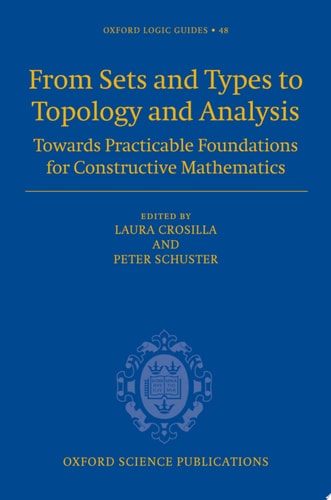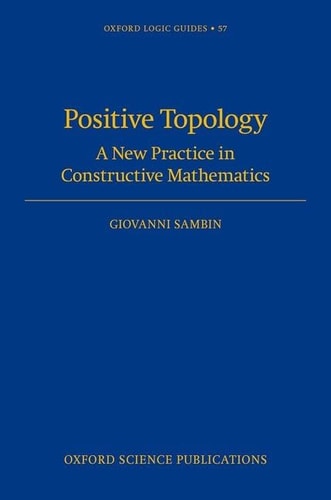
Positive Topology: A New Practice in Constructive Mathematics
0
0
As an Amazon Associate and affiliate partner, Menrva Books earns from qualifying purchases. Learn more
Author Description
Aimed at researchers in mathematics, philosophy and logic, this book provides the first organic exposition of dynamic constructivism and the mathematics ensuing in practice, including discussion of the technical development of the field and outlining the philosophical and methodological motivations underlying the evolution of the discipline.In dynamic constructivism, mathematics is seen as the result of a dynamic process of interaction between the construction of mathematical entities, by abstraction and by idealization, and their selection according to their efficiency in applications to reality and in the organisation of mathematics itself.The crucial benefit of this vision is its independence from dogmas and external authorities. A practical consequence is full respect for the diverse areas of mathematics - mainly computation, spatial intuition, deduction, and abstract axiomatic method - without reducing one to another. As a second consequence, a dynamic interaction between different 'epistemological levels' is always active and present, in the development of mathematics in practice, the study of its foundations and its formalisation in a computer language.
Menrva's Summary
THE THESIS
This book investigates the foundational principles and practical applications of dynamic constructivism within the field of mathematics. Giovanni Sambin, a prominent researcher in logic and mathematical foundations, presents a comprehensive framework that redefines mathematical entities as the product of dynamic interactions between construction, abstraction, and idealization. The text argues for a methodology that prioritizes efficiency and independence from traditional dogmas, offering a structured approach to integrating computation, spatial intuition, and axiomatic methods.
THE SCOPE MAP
What You Will Find
- A formal exposition of dynamic constructivism as a mathematical practice.
- Methodological analysis of the interaction between epistemological levels.
- Integration of computational theory with traditional spatial intuition and deduction.
- Philosophical motivations underlying the evolution of constructive mathematics.
THE AUTHORITY PERSPECTIVE
Experts identify this work as a foundational text for those interested in the intersection of logic and mathematical practice. Readers frequently note the high level of technical density, making it a primary resource for researchers in philosophy and formal logic.
Page Count:
624
Publication Date:
2024-07-17
Publisher:
Oxford University Press
ISBN-10:
0199232881
ISBN-13:
9780199232888
Philosophy
Logic
Topology
Constructive Mathematics
Mathematics
Community Tags
Similar Books