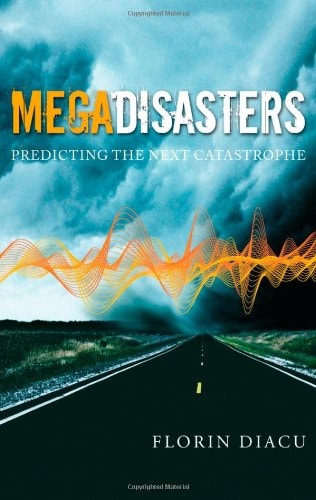
Megadisasters: Predicting the Next Catastrophe
0
0
As an Amazon Associate and affiliate partner, Menrva Books earns from qualifying purchases. Learn more
Author Description
No one can forget the horrific images of the destructive power of the tsunami that engulfed Southeast Asia on Boxing Day in 2004, or the chaos wrought by Hurricane Katrina. Could these 'megadisasters' have been predicted? This book is about the science and mathematics that underlies efforts to understand and predict megadisasters. There are similarities in the variety of cataclysms that we are prone to, whether hurricanes, tsunamis, sudden changes of climate, or stock market crashes. These are all events that are associated with complex systems, with many variables, and their science and mathematics is that of 'chaotic systems'. Their behaviour is very difficult to predict. Other kinds of megadisasters are the risk of a massive asteroid impact, and the development of pandemics. Understanding and predicting these phenomena involve developing complex mathematical models, and we have a long way to go. In this book, Diacu describes the struggles of mathematicians and scientists over the centuries to get to grips with the nature of volcanoes, hurricanes, and other complex phenomena and prevent future tragedies. But he also includes human stories that remind us of their terrifying power and the experience of being caught up in them.
Menrva's Summary
THE THESIS
This book investigates the scientific and mathematical frameworks required to understand and predict complex, large-scale catastrophic events. Florin Diacu, a mathematician, examines the inherent unpredictability of chaotic systems that govern phenomena ranging from natural disasters to economic collapses. He argues that while current modeling capabilities remain limited, the ongoing efforts of the scientific community are critical for mitigating future risks. The text bridges the gap between abstract mathematical theory and the tangible, often devastating, human experience of these events.
THE SCOPE MAP
What You Will Find
- Analysis of chaotic systems and their application to hurricanes, tsunamis, and climate shifts
- Examination of the mathematical challenges in modeling complex variables
- Historical overview of scientific attempts to predict natural disasters
- Case studies on diverse threats including asteroid impacts, pandemics, and stock market crashes
THE AUTHORITY PERSPECTIVE
Readers and reviewers frequently note that Diacu successfully translates dense mathematical concepts into accessible prose for a general audience. Experts highlight this work as a useful introduction to the intersection of chaos theory and disaster management.
Page Count:
260
Publication Date:
2009-01-01
Publisher:
Oxford University Press
ISBN-10:
0199237786
ISBN-13:
9780199237784
Science
Chaos Theory
Applied
Mathematics
Environment
Community Tags
Similar Books