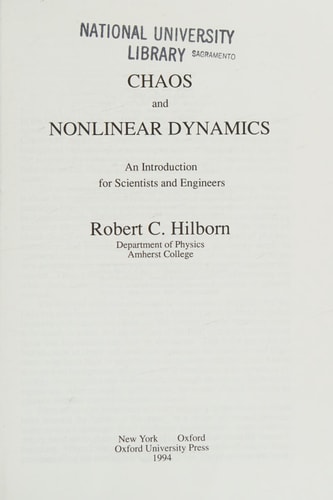
Chaos and Nonlinear Dynamics: An Introduction for Scientists and Engineers
0
0
As an Amazon Associate and affiliate partner, Menrva Books earns from qualifying purchases. Learn more
Author Description
Chaos and Nonlinear Dynamics introduces students, scientists, and engineers to the full range of activity in the rapidly growing field on nonlinear dynamics. Using a step-by-step introduction to dynamics and geometry in state space as the central focus of understanding nonlinear dynamics, this book includes a thorough treatment of both differential equation models and iterated map models (including a derivation of the famous Feigenbaum numbers). It is the only book at this level to include the increasingly important field of pattern formation and a survey of the controversial questions of quantum chaos. Important tools such as Lyapunov exponents and fractal dimensions are treated in detail. With over 200 figures and diagrams, and analytic and computer exercises for every chapter, the book can be used as a course-text or for self-instruction. This second edition has been restructured to make the book even more useful as a course of the more complex examples and derivations have been moved to appendices. The extensive collection of annotated references has been updated through January 2000 and now includes listings of World Wide Web sites at many of the major nonlinear dynamics research centers.
Menrva's Summary
THE THESIS
This text investigates the fundamental principles of chaos and nonlinear dynamics, providing a comprehensive framework for understanding complex systems in science and engineering. Robert C. Hilborn, a physicist, synthesizes mathematical theory with practical application to guide readers from basic calculus and physics concepts to advanced research frontiers. The book utilizes a structured approach, focusing on state space geometry, differential equations, and iterated maps to explain how chaotic behavior emerges in physical systems.
THE SCOPE MAP
What You Will Find
- Detailed analysis of differential equation models and iterated map models.
- Quantitative tools including Lyapunov exponents and fractal dimensions.
- Exploration of pattern formation and the theoretical implications of quantum chaos.
- Pedagogical resources such as over 200 diagrams and chapter-specific computer exercises.
THE AUTHORITY PERSPECTIVE
Experts and reviewers in the American Journal of Physics recognize this work as a foundational text that bridges the gap between introductory physics and advanced research. Readers frequently note the clarity of the explanations, making it a highly regarded resource for both classroom instruction and independent study.
Page Count:
0
Publication Date:
2004-01-01
Publisher:
OUP
ISBN-10:
0195671732
ISBN-13:
9780195671735
Science
Physics
Nonlinear Dynamics
Mathematics
Applied
Chaos Theory
Engineering
Community Tags
Similar Books