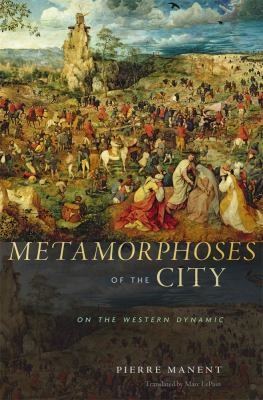
Metamorphoses of the City on the Western Dynamic
0
0
As an Amazon Associate and affiliate partner, Menrva Books earns from qualifying purchases. Learn more
Author Description
What is the best way to govern ourselves? The history of the West has been shaped by the struggle to answer this question, according to Pierre Manent. A major achievement by one of Europe's most influential political philosophers, Metamorphoses of the City is a sweeping interpretation of Europe's ambition since ancient times to generate ever better forms of collective self-government, and a reflection on what it means to be modern. Manent's genealogy of the nation-state begins with the Greek city-state, the polis. With its creation, humans ceased to organize themselves solely by family and kinship systems and instead began to live politically. Eventually, as the polis exhausted its possibilities in warfare and civil strife, cities evolved into empires, epitomized by Rome, and empires in turn gave way to the universal Catholic Church and finally the nation-state. Through readings of Aristotle, Augustine, Montaigne, and others, Manent charts an intellectual history of these political forms, allowing us to see that the dynamic of competition among them is a central force in the evolution of Western civilization.Scarred by the legacy of world wars, submerged in an increasingly technical transnational bureaucracy, indecisive in the face of proliferating crises of representative democracy, the European nation-state, Manent says, is nearing the end of its line. What new metamorphosis of the city will supplant it remains to be seen.
Menrva's Summary
THE THESIS
The history of Western civilization is a continuous struggle to define the best way to govern ourselves. Pierre Manent, a prominent political philosopher, traces this evolution from the ancient Greek city-state to the modern nation-state, examining how political forms have transformed in response to internal dynamics and external competition. Through critical readings of key thinkers like Aristotle and Augustine, Manent argues that the competition among these forms has been a driving force in Western development. He concludes by reflecting on the current state of the nation-state and the potential for future metamorphoses of collective self-government.
THE SCOPE MAP
- A genealogical analysis of Western political forms, beginning with the Greek polis.
- An examination of the evolution from city-state to empire, the Catholic Church, and the nation-state.
- Interpretations of foundational texts by philosophers such as Aristotle, Augustine, and Montaigne.
- An exploration of the concept of political self-government as a defining characteristic of Western civilization.
- A reflection on the current challenges facing the European nation-state and speculation on its future.
- An intellectual history of political organization and its impact on modernity.
THE AUTHORITY PERSPECTIVE
This work is regarded as a significant contribution by a leading European political philosopher, offering a sweeping interpretation of Western political evolution. The book is noted for its ambitious scope, tracing the development of collective self-government from antiquity to the present day. Its analysis, grounded in readings of major thinkers, highlights the dynamic of competition among political forms as a key driver of Western civilization. The author's concluding thoughts on the future of the nation-state provide a contemporary relevance to this historical and philosophical inquiry.
Page Count:
376
Publication Date:
2013-01-01
ISBN-10:
0674072944
ISBN-13:
9780674072947
Politics
Non-Fiction
Western
History
European History
Political Philosophy
Sociology
Community Tags
Similar Books