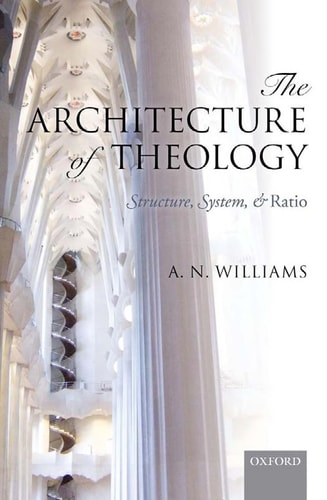
The Architecture of Theology: Structure, System, and Ratio
0
0
As an Amazon Associate and affiliate partner, Menrva Books earns from qualifying purchases. Learn more
Author Description
The Architecture of Theology presents a fresh reading of Christian theology, re-interpreting discussions of theological method and considering them in light of contemporary philosophical debates. A. N. Williams re-evaluates the traditional theological warrants (scripture, tradition, and reason) and the concept of systematic theology, arguing that Christian theology is inherently systematic, reflecting the rationality and relationality of its two chief subjects, 'God and other things as they are related to God'(Aquinas). The roles of the theological warrants are assessed, showing how they are necessarily interdependent. Contemporary philosophical discussions of the structure of reasoning are also examined; these have conventionally contrasted foundationalist and coherentist accounts. A contemporary consensus has emerged, however, of a chastened foundationalism or hybrid foundationalism-coherentism, in light of which arguments are understood both as reasoning from foundational propositions and as gaining plausibility from the coherence of claims with one another.The Christian tradition anticipated these developments: theological arguments exhibit a dual structure, with propositions underwritten to some extent by their dependence on scripture and tradition and to some extent by their coherence with one another in integrated webs, or systems. Christian theology is therefore shown to be systematic in its fundamental structure, whether or not a given argument forms part of a 'systematic theology'. The systematicity of Christian theology is related to its subject matter, 'God and other things as they are related to God'. Theology's two chief subjects (God and humanity) are characterised by rationality and relationality.These are also the qualities of Christian theology itself: it is a double mimesis, reflecting in its very structures of reasoning its subject matter.The order, harmony and coherence of those structures, however, have an aesthetic appeal which has the potential to appeal for its very beauty, rather than its truth. Williams presents a careful examination of the tradition of theological aesthetics, asking whether the beauty of systematic structures counts for or against theological truth.
Menrva's Summary
THE THESIS
This work investigates whether Christian theology possesses an inherently systematic structure that mirrors the rationality and relationality of its primary subject matter, God. A. N. Williams, a scholar of historical and systematic theology, utilizes the Thomistic framework of 'God and other things as they are related to God' to re-examine traditional theological warrants. By integrating contemporary philosophical debates regarding foundationalism and coherentism, the author argues that theological reasoning functions as a hybrid system where propositions derive validity from both foundational sources and their internal coherence within an integrated web of claims.
THE SCOPE MAP
What You Will Find
- An analysis of traditional theological warrants including scripture, tradition, and reason.
- A comparative study between classical theological methods and modern philosophical models of reasoning.
- An exploration of the concept of 'double mimesis' in theological structure.
- A systematic evaluation of how the relational nature of God informs the logical architecture of theological discourse.
THE AUTHORITY PERSPECTIVE
Scholars and students of systematic theology frequently cite this text for its rigorous synthesis of medieval scholasticism and contemporary epistemology. Experts highlight the book as a significant contribution to the ongoing dialogue between analytic philosophy and traditional Christian dogmatics.
Page Count:
272
Publication Date:
2011-09-21
Publisher:
Oxford University Press
ISBN-10:
0199236364
ISBN-13:
9780199236367
Religion
Philosophy
Systematic Theology
Theology
Christianity
Community Tags
Similar Books


Reader Comments
Share Your Thoughts
No comments yet. Be the first to share your thoughts!