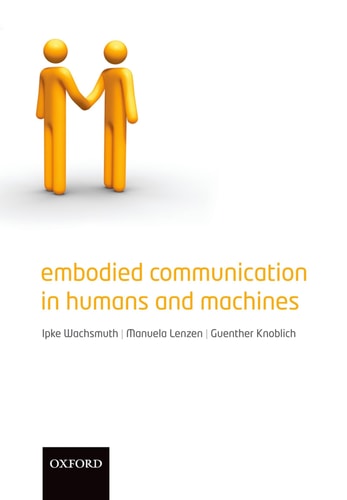
Embodied Communication: Integrating Cognitive Neuroscience and Robotics
0
0
As an Amazon Associate and affiliate partner, Menrva Books earns from qualifying purchases. Learn more
Author Description
When people communicate face to face they don't just exchange verbal information. Rather, communication encompasses the whole body. Communication partners synchronize their body sway, and mimic or imitate each other's body postures and actions. They produce a multitude of manual and facial gestures that help to illustrate what is being said, show how communication partners feel, or give away verbal cues. Moreover, face-to-face communication takes place in shared contexts where partners jointly attend and refer to the same objects, often while working on joint tasks such as carrying a table or repairing a car together.Traditionally, communication research has neglected these parts of communication using the engineering model of signal transmission as the main theoretical metaphor. This book takes a new look at recent empirical findings in the cognitive neurosciences, showing that the traditional approach is insufficient, and presenting a new interdisciplinary perspective, the Embodied Communication perspective. The core claim of the Embodied Communication perspective is that human communication involves parallel and highly interactive couplings between communication partners. These couplings range from low-level systems for performing and understanding instrumental actions, like the mirror system, to higher-systems that interpret symbols in a cultural context. The book can also serve as a guide for engineers who construct artificial agents and robots that should be able to interact with humans.
Menrva's Summary
THE THESIS
This book investigates the limitations of traditional signal-transmission models in communication research by proposing an Embodied Communication perspective. The authors, drawing on their expertise in cognitive neuroscience and human-computer interaction, argue that human interaction is defined by parallel, interactive couplings between partners. They synthesize empirical data to demonstrate that communication is a holistic process involving physical synchronization, gesture, and shared environmental context rather than mere verbal exchange.
THE SCOPE MAP
What You Will Find
- Analysis of non-verbal communication mechanisms including body sway, posture mimicry, and manual gestures.
- Examination of the mirror system and its role in understanding instrumental actions.
- Integration of cognitive neuroscience findings with practical applications for artificial agent and robot design.
- Theoretical framework for interpreting communication within shared cultural and task-oriented contexts.
THE AUTHORITY PERSPECTIVE
Experts recognize this work as a significant interdisciplinary bridge between cognitive science and human-robot interaction design. Readers frequently note that the text provides a necessary shift in perspective for engineers and researchers moving away from purely computational models of communication.
Page Count:
461
Publication Date:
1998-08-06
Publisher:
Academic Press
ISBN-10:
0199231753
ISBN-13:
9780199231751
Psychology
Communication
Communication Studies
Neuroscience
Robotics
Body Language
Community Tags
Similar Books