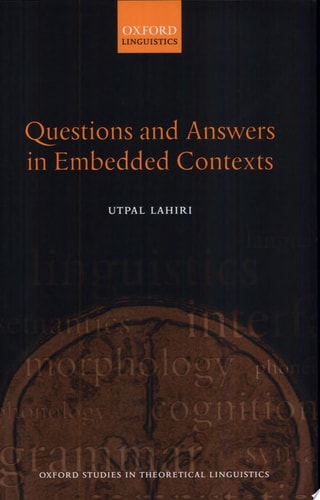
Questions and Answers in Embedded Contexts (Oxford Studies in Theoretical Linguistics)
0
0
As an Amazon Associate and affiliate partner, Menrva Books earns from qualifying purchases. Learn more
Author Description
Linguists have realized for some time that predicates of the "know" and "wonder" classes behave differently in semantic terms with respect to their interrogative complements, but have not so far fully understood how or why. This book seeks to explore and to provide solutions to this and to related problems in explaining the meaning and grammar of embedded interrogatives and the predicates that take interrogative complements (indirect questions and how they are answered).
Menrva's Summary
THE THESIS
This book investigates the semantic and syntactic mechanisms that differentiate how predicates like 'know' and 'wonder' interact with interrogative complements. Utpal Lahiri, a scholar in theoretical linguistics, utilizes formal semantic frameworks to analyze the logical structure of embedded questions. The text addresses the long-standing problem of why certain verbs permit specific types of interrogative complements while others do not, proposing a unified theory of indirect questions.
THE SCOPE MAP
What You Will Find
- Formal semantic analysis of interrogative complementation
- Comparative study of 'know' class versus 'wonder' class predicates
- Theoretical framework for the meaning and grammar of indirect questions
- Examination of the relationship between interrogative syntax and semantic interpretation
THE AUTHORITY PERSPECTIVE
Experts in theoretical linguistics recognize this work as a rigorous contribution to the study of embedded interrogatives within the Oxford Studies in Theoretical Linguistics series. Readers frequently note the high level of technical density and the formal precision required to engage with the author's proposed solutions.
Page Count:
320
Publication Date:
2002-03-28
Publisher:
Oxford University Press
ISBN-10:
0199246521
ISBN-13:
9780199246526
Linguistics
Grammar
Syntax
Semantics
Academic
Community Tags
Similar Books