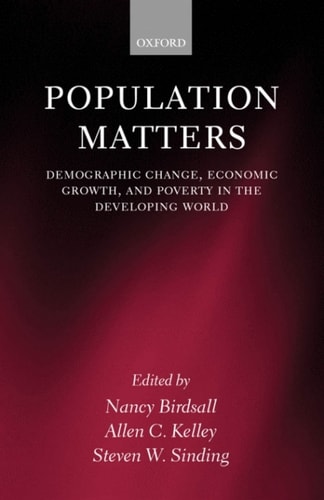
Population Matters: Demographic Change, Economic Growth, and Poverty in the Developing World
0
0
As an Amazon Associate and affiliate partner, Menrva Books earns from qualifying purchases. Learn more
Author Description
Does rapid population growth diminish countries' economic development prospects? Do policies aimed at reducing high fertility help families escape poverty? These questions have been at the heart of policy debates since the time of Malthus, and have been particularly heated during the last half-century of explosive Third World population growth. In this carefully constructed collection of recent studies and analyses, the authors offer a nuanced, yet clear and positive answer to these questions---a refreshing step forward from the ambiguous conclusions of much of the literature of the 1970s and 1980s.
Menrva's Summary
THE THESIS
This work investigates whether rapid population growth serves as a primary impediment to economic development and poverty reduction in the developing world. The authors, Allen C. Kelley, Nancy Birdsall, and Steven Sinding, utilize a synthesis of demographic data and economic modeling to challenge the Malthusian pessimism that dominated policy discourse in the late 20th century. By analyzing the interplay between fertility rates and household welfare, the text argues that targeted policy interventions can foster sustainable economic growth rather than merely reacting to population surges.
THE SCOPE MAP
What You Will Find
- Comparative analysis of demographic trends across various developing nations.
- Economic frameworks linking fertility reduction to household poverty alleviation.
- Empirical evidence derived from longitudinal studies of Third World population growth.
- Policy recommendations for integrating demographic planning into national economic strategies.
THE AUTHORITY PERSPECTIVE
Experts recognize this volume as a significant departure from the ambiguous conclusions prevalent in 1970s and 1980s demographic literature. Scholars frequently cite the text for its clear, evidence-based approach to the complex relationship between population dynamics and national economic health.
Page Count:
456
Publication Date:
2001-10-24
Publisher:
Oxford University Press
ISBN-10:
0199244073
ISBN-13:
9780199244072
Economics
Poverty
Demography
Sociology
Developing Countries