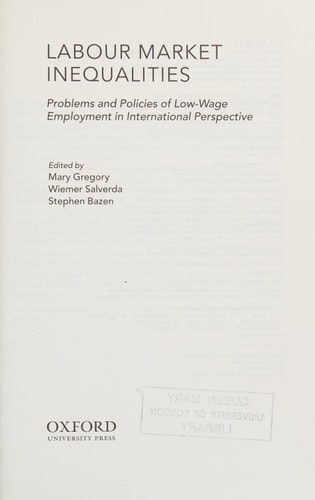
Labour Market Inequalities: Problems and Policies of Low-Wage Employment in International Perspective
0
0
As an Amazon Associate and affiliate partner, Menrva Books earns from qualifying purchases. Learn more
Author Description
Contributions to this volume review, in international perspective, the "European social model" of collective bargaining, minimum wages, employment rights, and social welfare support, which is seen as both cause and cure for joblessness and low-wage employment in Europe. They find that collective bargaining and minimum wages protect vulnerable workers, while wage flexibility is not economically effective in creating jobs for the low-skilled.
Menrva's Summary
THE THESIS
This volume investigates the structural causes of low-wage employment and the efficacy of various policy interventions within the European social model. Edited by Mary Gregory with contributions from Wiemer Salverda and Stephen Bazen, the text synthesizes comparative international data to evaluate how collective bargaining, minimum wage legislation, and social welfare systems influence labor market outcomes. The authors argue that traditional mechanisms of worker protection remain vital for vulnerable populations, challenging the assumption that increased wage flexibility serves as a primary driver for job creation among low-skilled workers.
THE SCOPE MAP
What You Will Find
- Comparative analysis of the European social model across multiple nations
- Evaluation of collective bargaining and minimum wage impacts on worker protection
- Assessment of the relationship between wage flexibility and employment rates for low-skilled labor
- Examination of social welfare support systems as both a cause and potential cure for joblessness
THE AUTHORITY PERSPECTIVE
Experts identify this work as a significant contribution to labor economics, particularly for its critical examination of European policy frameworks. Readers frequently note the academic density of the prose and the rigorous reliance on comparative data to support its conclusions.
Page Count:
264
Publication Date:
2000-12-28
Publisher:
Oxford University Press
ISBN-10:
0199241694
ISBN-13:
9780199241699
Economics
Labor Supply
Public Policy
Minimum wage
Social Welfare
Wages
Sociology
Community Tags
Similar Books