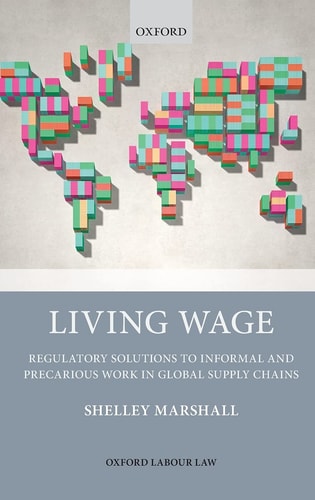
Living Wage: Regulatory Solutions to Informal and Precarious Work in Global Supply Chains
0
0
As an Amazon Associate and affiliate partner, Menrva Books earns from qualifying purchases. Learn more
Author Description
This book is driven by a quest to re-regulate work to reduce informality and inequality, and promote a living wage for more people across the world. It presents the findings of a multidisciplinary study in four countries of varying wealth and development, exploring why people become trapped in precarious work. The accounts describe the impact of supply chain governance, trade agreements, internal and between-country migration, legal factors, as well as the socio-economic characteristics and outlooks of the workers.In a unique approach, the chapters describe existing labour regulation measures that have succeeded, but which have to date attracted little scholarly attention. Building on these existing innovations, the book proposes a new international labour law which would incrementally increase the wages of the poor and regulate precarious work in global supply chains.
Menrva's Summary
THE THESIS
This book investigates how international labour law can be re-regulated to mitigate informality and precarious employment while establishing a global living wage. Shelley Marshall, a scholar in labour law and regulation, synthesizes multidisciplinary research across four nations to identify the structural drivers of economic inequality. The text argues that existing, under-researched regulatory innovations provide a viable framework for a new international legal standard that protects vulnerable workers within global supply chains.
THE SCOPE MAP
What You Will Find
- Comparative analysis of labour regulation across four countries with varying levels of economic development.
- Examination of the impact of trade agreements and supply chain governance on worker stability.
- Investigation into the socio-economic factors and migration patterns that contribute to precarious work.
- A proposed framework for international labour law reform aimed at incremental wage increases for the global poor.
THE AUTHORITY PERSPECTIVE
Experts identify this work as a significant contribution to the field of international labour law, particularly for its focus on practical, existing regulatory successes. Readers frequently note the academic density of the prose and the rigorous, evidence-based approach to policy reform.
Page Count:
240
Publication Date:
2019-03-24
Publisher:
Oxford University Press
ISBN-10:
0198830351
ISBN-13:
9780198830351
Economics
Sociology
Minimum wage
Labour Law
Labor Supply
Public Policy
Professional Career & Trade
Human rights
Global Supply Chains
Community Tags
Similar Books