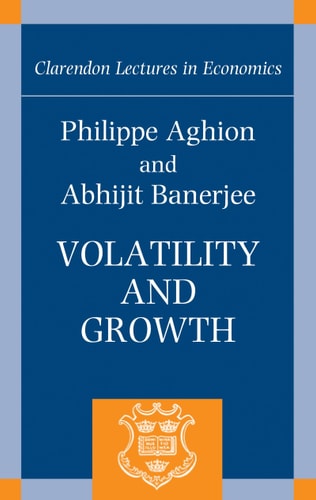
Volatility and Growth
0
0
As an Amazon Associate and affiliate partner, Menrva Books earns from qualifying purchases. Learn more
Author Description
It has long been recognized that productivity growth and the business cycle are closely interrelated. Yet, until recently, the two phenomena have been investigated separately in the economics literature. This book provides the first consistent attempt to analyze the effects of macroeconomic volatility on productivity growth, and also the reverse causality from growth to business cycles. The authors show that by looking at the economy through the lens of private entrepreneurs, who invest under credit constraints, one can go some way towards explaining persistent macroeconomic volatility and the effects of volatility on growth. Beginning with an analysis of the effects of volatility on growth, the authors argue that the lower the level of financial development in a country the more detrimental the effect of volatility on growth. This prediction is confirmed by cross-country panel regressions. The data also suggests that a fixed exchange rate regime or more countercyclical budgetary policies are growth-enhancing in countries with a lower level of financial development. The former reduce aggregate volatility whereas the latter reduce the negative effects of volatility on long-term productivity-enhancing investment by firms. The book concludes with an investigation into how the interplay between credit constraints and pecuniary externalities is sufficient to generate persistent business cycles and to explain the occurrence of currency crises.
Menrva's Summary
THE THESIS
This book investigates the complex, bidirectional relationship between macroeconomic volatility and long-term productivity growth. Authors Abhijit Vinayak Banerjee and Philippe Aghion, both distinguished economists, utilize a framework centered on private entrepreneurs operating under credit constraints to explain how financial development levels dictate the impact of economic instability. By integrating theoretical modeling with empirical cross-country panel regressions, the authors demonstrate how specific policy interventions can mitigate the negative consequences of volatility on growth.
THE SCOPE MAP
What You Will Find
- Analysis of the causal link between business cycles and productivity growth
- Theoretical models of investment behavior under credit constraints
- Empirical evidence from cross-country panel regressions regarding financial development
- Policy evaluations of exchange rate regimes and countercyclical budgetary measures
THE AUTHORITY PERSPECTIVE
Experts recognize this work as a foundational text for understanding the intersection of growth theory and business cycle fluctuations. Readers frequently note the technical rigor of the prose, which is intended for advanced students and professional economists.
Page Count:
160
Publication Date:
2005-09-29
Publisher:
Oxford University Press
ISBN-10:
0199248613
ISBN-13:
9780199248612
Business
Economics
Finance
Macroeconomics
Community Tags
Similar Books