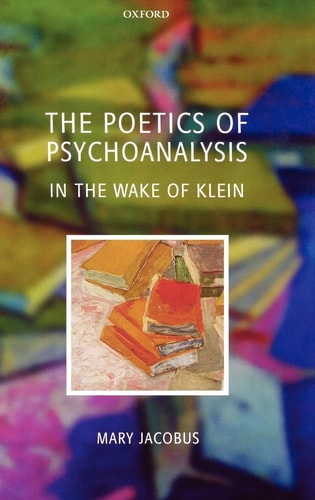
The Poetics of Psychoanalysis: In the Wake of Klein
0
0
As an Amazon Associate and affiliate partner, Menrva Books earns from qualifying purchases. Learn more
Author Description
The Poetics of Psychoanalysis explores the literary aspects of the twentieth-century psychoanalytic tradition that has come to be known as British Object Relations psychoanalysis. Focussing on Melanie Klein's legacy to psychoanalysis between the 1930s and 1970s, it deals with major figures such as Riviere, Isaacs, Winnicott, Milner, and Bion, as well as Klein's contemporary, Ella Sharpe. Mary Jacobus breaks new ground by giving a central place to the literary and aesthetic concerns of the British Object Relations tradition. Paying close attention to writing that is often side-lined by literary critics and theorists, she makes fruitful connections with particular works of literature and art, along with pressing contemporary issues.The three sections focus on the transitions, mediations, and transformations that took place in British Object Relations psychoanalysis as Klein's ideas were developed and transformed. Situating Kleinian thought in relation to later developments and differences, while making it accessible to non-psychoanalytic readers, The Poetics of Psychoanalysis argues against the separation of British and continental traditions and for the continuing links between psychoanalysis and aesthetics. Rather than applying psychoanalytic ideas to literature and aesthetics, the book traces the British Object Relations tradition as a form of proto-modernist discourse in its own right. Linked by a common thread of ideas and structured to reflect a roughly chronological trajectory, individual chapters can also be read as free-standing critical essays. Aimed at literary readers, this book will also be of interest to psychoanalytic practitioners and cultural theorists.
Menrva's Summary
THE THESIS
This book investigates the intersection of British Object Relations psychoanalysis and literary aesthetics, arguing that the tradition functions as a form of proto-modernist discourse. Mary Jacobus, a scholar of literature and psychoanalytic theory, utilizes a rigorous critical framework to examine how the works of Melanie Klein and her successors—including Winnicott, Milner, and Bion—engage with aesthetic concerns. By analyzing these psychoanalytic texts as creative writing, the author challenges the traditional separation between clinical practice and literary theory.
THE SCOPE MAP
What You Will Find
- An analysis of the British Object Relations tradition from the 1930s through the 1970s.
- A critical examination of major figures such as Melanie Klein, D.W. Winnicott, Marion Milner, and Wilfred Bion.
- A methodology that treats psychoanalytic writing as a form of proto-modernist discourse rather than merely a clinical tool.
- A thematic exploration of the transitions, mediations, and transformations within the Kleinian school of thought.
THE AUTHORITY PERSPECTIVE
Scholars and practitioners frequently cite this work for its ability to bridge the gap between clinical psychoanalytic theory and literary criticism. Experts highlight the text as a sophisticated resource for those interested in the aesthetic dimensions of the British Object Relations school.
Page Count:
318
Publication Date:
2006-02-16
Publisher:
Oxford University Press
ISBN-10:
019924636X
ISBN-13:
9780199246366
Psychology
Philosophy
Aesthetics
Psychoanalysis
Literary Criticism
Community Tags
Similar Books