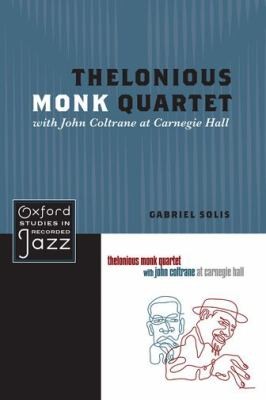
Thelonious Monk Quartet Featuring John Coltrane At Carnegie Hall
0
0
As an Amazon Associate and affiliate partner, Menrva Books earns from qualifying purchases. Learn more
Author Description
In early 2005, an engineer at the Library of Congress accidentally discovered, in an unmarked box, the recording of Thelonious Monk's and John Coltrane's performance at a 1957 benefit concert at Carnegie Hall. Long considered one of the most important musical meetings in modern jazz, Monk's and Coltrane's work together during a scant few months in 1957 had, until this discovery, been thought to be almost entirely undocumented. In this book, Gabriel Solis provides an historical, cultural, and analytical study of this landmark recording, which was released by Blue Note records later in 2005. Taking a wide-ranging approach to the recording, Solis addresses issues of "liveness," jazz teaching and learning, enculturation, and historiography. Because nearly a half century passed between when the recording was made and its public release, it is a particularly interesting lens through which to view jazz both as a historical tradition and as a contemporary cultural form. Most importantly Solis accounts for the music itself. Offering in depth analytical discussions of each composition, as well as Monk's and Coltrane's improvisational performances he provides insight into Monk's impact on Coltrane as he developed his signature "sheets of sound" style, as well as into the influence of a strong side-man, like Coltrane, on Monk at his creative and professional peak. The first study of one of the most significant jazz releases of the twenty-first century, Thelonious Monk Quartet with John Coltrane at Carnegie Hall is essential reading for all jazz scholars, students, musicians, and fans
Menrva's Summary
THE THESIS
The discovery of a lost recording of Thelonious Monk and John Coltrane performing together in 1957 prompts a multifaceted examination of its historical, cultural, and musical significance. Gabriel Solis, drawing on his expertise in musicology and cultural studies, analyzes the landmark 2005 release of this performance. The book investigates concepts of 'liveness' in jazz, the pedagogical aspects of jazz, and the historiography surrounding such a significant event. By considering the nearly fifty-year gap between the recording and its release, Solis explores jazz as both a historical tradition and a living cultural form, offering in-depth musical analysis of each composition and the improvisational performances of Monk and Coltrane.
THE SCOPE MAP
- Historical context of the 1957 Carnegie Hall benefit concert.
- Analysis of the musical interplay between Thelonious Monk and John Coltrane.
- Exploration of Coltrane's development of the 'sheets of sound' style.
- Discussion of the influence of a strong sideman on Monk's creative peak.
- Examination of 'liveness' and its implications for jazz recordings.
- Study of jazz teaching, learning, and enculturation.
- Consideration of jazz historiography and the impact of the recording's delayed release.
- In-depth analytical discussions of each composition performed.
THE AUTHORITY PERSPECTIVE
The book is positioned as essential reading for jazz scholars, students, musicians, and fans, marking it as a significant contribution to the study of one of the most important jazz releases of the 21st century. The author's approach is noted for its historical, cultural, and analytical depth, providing insights into the musical development of both Monk and Coltrane. The unique circumstance of the recording's delayed release allows for a nuanced perspective on jazz as both a historical and contemporary cultural form. The detailed musical analysis of the performances is a key feature highlighted in the description.
Page Count:
183
Publication Date:
2014-01-01
ISBN-10:
019974436X
ISBN-13:
9780199744367
Music
Art
Non-Fiction
History
Jazz Studies
Music History
Music Analysis
Community Tags
Similar Books