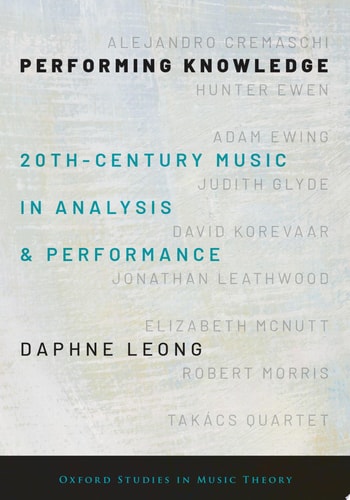
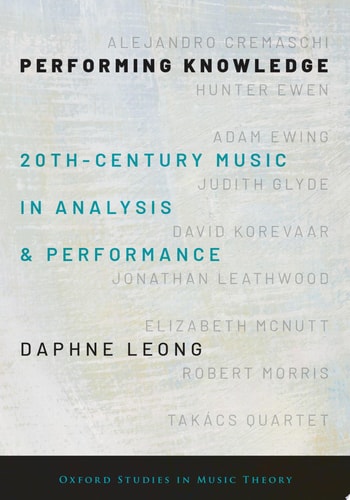
Performing Knowledge: Twentieth-Century Music in Analysis and Performance
0
0
As an Amazon Associate and affiliate partner, Menrva Books earns from qualifying purchases. Learn more
Author Description
How do musical analysis and performance relate? In a unique collaborative approach to this question, theorist-pianist Daphne Leong partners with internationally renowned performers to interpret twentieth-century repertoire. Imaginative explorations of music by Ravel, Schoenberg, Bartók, Schnittke, Milhaud, Messiaen, Babbitt, Carter, and Morris illuminate focal issues such as the role of embodiment, the affordances of a score, the cultural understanding of notation, the use of metaphor, and--to round out the viewpoints of theorist and performers with those of composer and listeners--the role of structure in audience reception. Each exploration engages deeply with musical structure, redefined to encompass the creative activity of composers, performers, analysts, and listeners. Performances, demonstrations, and interviews online complement the book's written text; practical application and pedagogical guidance round out theoretical and analytical content.The collaborations themselves demonstrate different dimensions of knowledge at the intersection of analysis and performance, and illustrate Leong's theory of the things and people that facilitate cross-disciplinary collaboration in music. They also exemplify the antagonisms and synergies that emerge when theorists and performers meet. Both flexibly and rigorously conceived, Performing Knowledge is a brave crossing of disciplinary divides between scholarship and practice, a work of analysis shaped by the voices of performers.
Menrva's Summary
THE THESIS
This book investigates the complex, often fraught relationship between musical analysis and performance practice within the context of twentieth-century repertoire. Daphne Leong, a theorist and pianist, utilizes a collaborative framework to bridge the gap between scholarly analysis and artistic execution. By integrating the perspectives of performers, composers, and listeners, the author argues that musical structure is a dynamic, multi-faceted construct rather than a static set of instructions found in a score.
THE SCOPE MAP
What You Will Find
- Detailed analytical case studies of works by Ravel, Schoenberg, Bartók, Schnittke, Milhaud, Messiaen, Babbitt, Carter, and Morris.
- A theoretical framework for cross-disciplinary collaboration between theorists and performers.
- Integration of digital media, including online performances, demonstrations, and interviews.
- Pedagogical strategies for applying analytical insights to performance practice.
Scope Limits
- The text focuses primarily on twentieth-century Western art music and does not address earlier historical periods or non-Western musical traditions.
- The analysis is limited to the specific repertoire selected for the collaborative case studies.
THE AUTHORITY PERSPECTIVE
Experts recognize this work as a significant contribution to the growing field of performance-based music theory. Readers frequently note the balance between rigorous analytical methodology and the practical, lived experience of the performing artist.
Page Count:
432
Publication Date:
2019-01-01
Publisher:
Oxford University Press
ISBN-10:
0190653566
ISBN-13:
9780190653569
Performance Studies
Humanities
Music theory
Music
Music History
Music Technology
Academic
Musicology
Music Analysis
Community Tags
Other Editions(2)
Similar Books