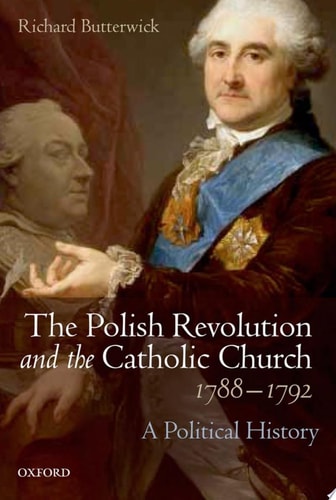
The Polish Revolution and the Catholic Church, 1788-1792: A Political History
0
0
As an Amazon Associate and affiliate partner, Menrva Books earns from qualifying purchases. Learn more
Author Description
The Polish Revolution cast off the Russian hegemony that had kept the Polish-Lithuanian Commonwealth impotent for most of the eighteenth century. Before being overthrown by the armies of Catherine the Great, the Four Years' Parliament of 1788-92 passed wide-ranging reforms, culminating in Europe's first written constitution on 3 May 1791.In some respects its policies towards the Catholic Church of both rites (Latin and Ruthenian) were more radical than those of Joseph II, and comparable to some of those adopted in the early stages of the French Revolution. Policies included taxation of the Catholic clergy at more than double the rate of the lay nobility, the confiscation of episcopal estates, the equalization of dioceses, and controversial concessions to Orthodoxy. But the monastic clergy escaped almost unscathed. A method of explaining political decisions in a republican polity is developed in order to show how and why the Commonwealth went to the verge of schism with Rome in 1789-90, before drawing back. Pope Pius VI could then bless the 'mild revolution' of 3 May 1791, which Poland's clergy and monarch presented to the nobility as a miracle of Divine Providence. The stresses would be eclipsed by dechristianization in France, the dismemberment of the Commonwealth, and subsequent incarnations of unity between the Catholic Church and the Polish nation.Probing both 'high politics' and political culture', Richard Butterwick draws on diplomatic and political correspondence, speeches, pamphlets, sermons, pastoral letters, proclamations, records of local assemblies, and other sources to explore a volatile relationship between altar, throne, and nobility at the end of Europe's Ancien Regime.
Menrva's Summary
THE THESIS
This work investigates how the Polish-Lithuanian Commonwealth navigated the complex intersection of state reform and ecclesiastical authority during the transformative period of 1788-1792. Richard Butterwick, a scholar specializing in the history of the Polish-Lithuanian Commonwealth, utilizes a vast array of primary sources—including diplomatic correspondence, sermons, and parliamentary records—to analyze the political culture of the era. He argues that the Commonwealth’s attempt to modernize its relationship with the Catholic Church was a deliberate, albeit volatile, political strategy that sought to balance republican ideals with religious tradition.
THE SCOPE MAP
What You Will Find
- Analysis of the Four Years' Parliament and the constitutional reforms of 1791.
- Examination of the taxation and land confiscation policies directed at the Catholic clergy.
- Comparative study of Polish ecclesiastical reforms versus those of Joseph II and the French Revolution.
- Exploration of the diplomatic tension between the Commonwealth and the Papacy under Pius VI.
THE AUTHORITY PERSPECTIVE
Historians recognize this text as a definitive account of the political and religious dynamics within the late Polish-Lithuanian Commonwealth. The prose is noted for its academic rigor and its ability to synthesize complex archival data into a coherent narrative of statecraft.
Page Count:
400
Publication Date:
2012-02-20
Publisher:
Oxford University Press
ISBN-10:
0199250332
ISBN-13:
9780199250332
Religion
History
European History
Church & State
Poland
18th century
Catholic Church
Europe
Political History
Community Tags
Similar Books