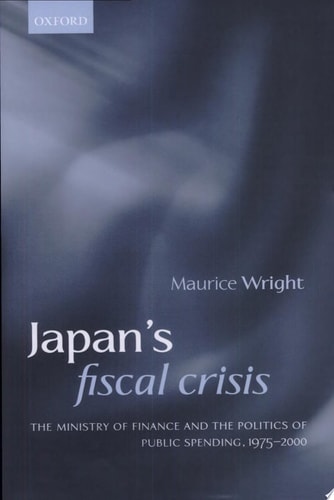
Japan's Fiscal Crisis: The Ministry of Finance and the Politics of Public Spending, 1975-2000
0
0
As an Amazon Associate and affiliate partner, Menrva Books earns from qualifying purchases. Learn more
Author Description
In this controversial and authoritative account of Japan's public budgeting and politics, the author traces the origins and development of Japan's present fiscal crisis. In a detailed analysis of the institutions, structures, and processes of central government, the role of the Ministry of Finance is analysed and its relationship with other ministries in deciding how much to spend and on what is examined. Drawing on a rich archive of interview material and primary budget data, the author explains how and why Japan accumulated the world's largest public debt.
Menrva's Summary
THE THESIS
This book investigates the institutional mechanisms and political dynamics that led to the accumulation of Japan's massive public debt between 1975 and 2000. Maurice Wright, a scholar of public administration, utilizes a rigorous framework to examine the central government's budgetary processes. By analyzing the internal operations of the Ministry of Finance and its interactions with other government bodies, the author argues that specific structural incentives and political compromises directly precipitated the nation's fiscal instability.
THE SCOPE MAP
What You Will Find
- Detailed analysis of the Ministry of Finance's role in central government budgeting.
- Examination of the political negotiations between competing ministries regarding public spending.
- Primary source data including extensive interview material and official budget records.
- A historical overview of Japanese fiscal policy evolution from 1975 to 2000.
THE AUTHORITY PERSPECTIVE
Experts recognize this work as a foundational study for understanding the bureaucratic complexities of the Japanese state during the late twentieth century. Readers frequently note the academic density of the prose, which provides a comprehensive look at the intersection of institutional power and economic policy.
Page Count:
648
Publication Date:
2002-05-23
Publisher:
Oxford University Press
ISBN-10:
0199250537
ISBN-13:
9780199250530
History
Economics
Public Policy
Fiscal Policy
Japan
Community Tags
Similar Books