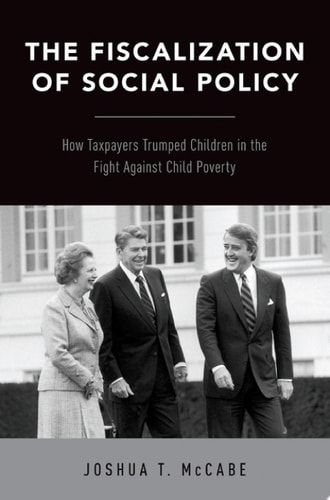
The Fiscalization of Social Policy: How Taxpayers Trumped Children in the Fight Against Child Poverty
0
0
As an Amazon Associate and affiliate partner, Menrva Books earns from qualifying purchases. Learn more
Author Description
In 1970, a single mother with two children working full-time at the federal minimum wage in the US received no direct cash benefits from the federal government. Today, after a period of austerity, that same mother would receive $7,572 in federal cash benefits. This money does not come from social assistance, family allowances, or other programs we traditionally see as part of the welfare state. Instead, she benefits from the earned income tax credit (EITC) and the child tax credit (CTC)-tax credits for low-income families that have become a major component of American social policy.In The Fiscalization of Social Policy, Joshua McCabe challenges conventional wisdom on American exceptionalism, offering the first and only comparative analysis of the politics of tax credits. Drawing comparisons between similar developments in the UK and Canada, McCabe upends much of what we know about tax credits for low-income families. Rather than attributing these changes to anti-welfare attitudes, mobilization of conservative forces, shifts toward workfare, or racial antagonism, he argues that the growing use of tax credits for social policy was a strategic adaptation to austerity. While all three countries employ the same set of tax credits, child US poverty rates remain highest, as their tax credits paradoxically exclude the poorest families.A critical examination of social policy over the last fifty years, The Fiscalization of Social Policy shows why the US government hasn't tackled poverty, even while it implements greater tax benefits for the poor.
Menrva's Summary
THE THESIS
This book investigates why the United States has increasingly relied on tax credits rather than traditional welfare programs to address child poverty, and why this shift has failed to effectively reduce poverty rates. Joshua T. McCabe, a political scientist, utilizes a comparative historical framework to analyze the evolution of social policy in the US, the UK, and Canada. He argues that the rise of tax credits like the EITC and CTC represents a strategic adaptation to fiscal austerity rather than a simple ideological shift toward workfare or conservative mobilization. By examining legislative trends over the last fifty years, he demonstrates how these fiscal mechanisms paradoxically exclude the most vulnerable populations.
THE SCOPE MAP
What You Will Find
- Comparative analysis of social policy evolution in the US, UK, and Canada.
- Examination of the Earned Income Tax Credit (EITC) and Child Tax Credit (CTC) mechanisms.
- Historical data on federal cash benefits and poverty rates from 1970 to the present.
- Analysis of the political constraints imposed by fiscal austerity.
Scope Limits
- Does not provide a comprehensive history of all social welfare programs outside of tax-based credits.
- Does not offer specific legislative proposals for future policy reform.
THE AUTHORITY PERSPECTIVE
Scholars and policy analysts recognize this work as a significant contribution to the study of American exceptionalism and the mechanics of the modern welfare state. Readers frequently note the academic density of the prose and the rigor of the comparative methodology employed by the author.
Page Count:
248
Publication Date:
2018-06-19
Publisher:
Oxford University Press
ISBN-10:
0190841303
ISBN-13:
9780190841300
Economics
Public welfare
Tax Credits
Fiscal Policy
Sociology
Public Policy
Social policy
Pool Family
Community Tags
Similar Books