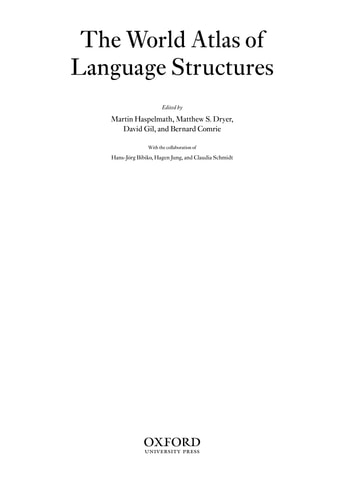
The World Atlas of Language Structures
0
0
As an Amazon Associate and affiliate partner, Menrva Books earns from qualifying purchases. Learn more
Author Description
The World Atlas of Language Structures is a book and CD combination displaying the structural properties of the world's languages. 142 world maps and numerous regional maps - all in colour - display the geographical distribution of features of pronunciation and grammar, such as number of vowels, tone systems, gender, plurals, tense, word order, and body part terminology. Each world map shows an average of 400 languages and is accompanied by a fully referenced description of the structural feature in question.The CD provides an interactive electronic version of the database which allows the reader to zoom in on or customize the maps, to display bibliographical sources, and to establish correlations between features. The book and the CD together provide an indispensable source of information for linguists and others seeking to understand human languages.The Atlas will be especially valuable for linguistic typologists, grammatical theorists, historical and comparative linguists, and for those studying a region such as Africa, Southeast Asia, North America, Australia, and Europe. It will also interest anthropologists and geographers. More than fifty authors from many different countries have collaborated to produce a work that sets new standards in comparative linguistics. No institution involved in language research can afford to be without it.
Menrva's Summary
THE THESIS
This work investigates the global distribution of structural properties across human languages to identify patterns in phonology, morphology, and syntax. Edited by a team of prominent linguists including Bernard Comrie and Matthew S. Dryer, the atlas synthesizes data from over 400 languages to provide a comprehensive typological framework. The authors utilize cartographic visualization to demonstrate how specific grammatical and phonetic features are geographically clustered or dispersed across the globe.
THE SCOPE MAP
What You Will Find
- 142 color-coded world maps illustrating linguistic features such as vowel systems, tone, and word order.
- An interactive CD-ROM database allowing for custom map generation and correlation analysis.
- Detailed, peer-reviewed descriptions of structural features including gender, plurals, and tense.
- Bibliographical references for each mapped feature to support further comparative research.
THE AUTHORITY PERSPECTIVE
Experts recognize this atlas as a foundational resource for linguistic typologists and comparative researchers. Readers frequently note the high density of the data and the technical rigor required to interpret the complex correlations presented in the text.
Page Count:
693
Publication Date:
2005-10-06
Publisher:
Oxford University Press
ISBN-10:
0199255911
ISBN-13:
9780199255917
Geography
Anthropology
Linguistics
Reference
Academic
Comparative linguistics
Community Tags
Similar Books