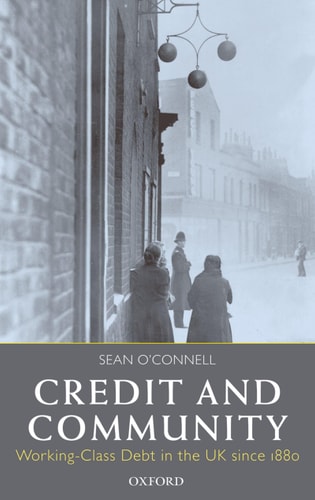
Credit and Community: Working-Class Debt in the UK since 1880
0
0
As an Amazon Associate and affiliate partner, Menrva Books earns from qualifying purchases. Learn more
Author Description
Credit and Community examines the history of consumer credit and debt in working class communities. Concentrating on forms of credit that were traditionally very dependent on personal relationships and social networks, such as mail-order catalogues and co-operatives, it demonstrates how community-based arrangements declined as more impersonal forms of borrowing emerged during the twentieth century.Tallymen and check traders moved into doorstep money-lending during the 1960s, but in subsequent decades the loss of their best working class customers, owing to increased spending power and the emergence of a broader range of credit alternatives, forced them to focus on the 'financially excluded'. This 'sub-prime' market was open for exploitation by unlicensed lenders, and Sean O'Connell offers the first detailed historical investigation of illegal money-lending in the UK, encompassing the 'she usurers' of Edwardian Liverpool and the violent loan sharks of Blair's Britain.O'Connell contrasts such commercial forms of credit with formal and informal co-operative alternatives, such as "diddlum clubs," "partners," and mutuality clubs. He provides the first history of the UK credit unions, revealing the importance of Irish and Caribbean immigrant volunteers, and explains the relative failure of the movement compared with Ireland.Drawing on a wide range of neglected sources, including the archives of consumer credit companies, the records of the co-operative and credit union movements, and government papers, Credit and Community makes a strong contribution to historical understandings of credit and debt. Oral history testimony from both sides of the credit divide is used to telling effect, offering key insights into the complex nature of the relationship between borrowers and lenders.
Menrva's Summary
THE THESIS
This book investigates the historical evolution of consumer credit and debt within working-class communities in the United Kingdom from 1880 to the present. Sean O'Connell, a historian specializing in social and economic history, utilizes a combination of corporate archives, government records, and oral history testimonies to trace the shift from community-based, relationship-driven lending to the rise of impersonal, commercialized credit systems. The work argues that the decline of traditional mutual aid structures facilitated the emergence of predatory, sub-prime lending practices that continue to impact financially excluded populations.
THE SCOPE MAP
What You Will Find
- Historical analysis of informal credit systems including tallymen, check traders, and diddlum clubs.
- Examination of the rise and relative stagnation of the UK credit union movement compared to Irish counterparts.
- Primary source research derived from consumer credit company archives and government policy papers.
- Qualitative data provided through oral history interviews with both borrowers and lenders.
THE AUTHORITY PERSPECTIVE
Experts recognize this work as a foundational historical study of the intersection between social class and financial exclusion in Britain. Readers frequently note the density of the archival research and the effectiveness of the oral history components in humanizing complex economic trends.
Page Count:
280
Publication Date:
2009-03-15
Publisher:
Oxford University Press
ISBN-10:
0199263310
ISBN-13:
9780199263318
History
Economics
Debt
Social Science
Consumer Credit
Finance
Working class
United Kingdom
Community Tags
Similar Books