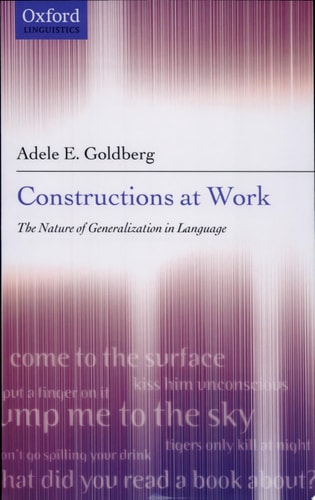
Constructions at Work: The Nature of Generalization in Language
0
0
As an Amazon Associate and affiliate partner, Menrva Books earns from qualifying purchases. Learn more
Author Description
This book investigates the nature of generalization in language and examines how language is known by adults and acquired by children. It looks at how and why constructions are learned, the relation between their forms and functions, and how cross-linguistic and language-internal generalizations about them can be explained.Constructions at Work is divided into three parts: in the first Professor Goldberg provides an overview of constructionist approaches, including the constructionist approach to argument structure, and argues for a usage-based model of grammar. In Part II she addresses issues concerning how generalizations are constrained and constructional generalizations are learned. In Part III the author shows that a combination of function and processing accounts for a wide range of language-internal and cross-linguistic generalizations. She then considers the degree to which the function of constructions explains their distribution and examines cross-linguistic tendencies in argument realization. She demonstrates that pragmatic and cognitive processes account for the data without appeal to stipulations that are language-specific.This book is an important contribution to the study of how language operates in the mind and in the world and how these operations relate. It is of central interest for scholars and graduate-level students in all branches of theoretical linguistics and psycholinguistics. It will also appeal to cognitive scientists and philosophers concerned with language and its acquisition.
Menrva's Summary
THE THESIS
This book investigates the fundamental nature of linguistic generalization and the mechanisms through which language is acquired and processed by the human mind. Adele Goldberg, a prominent figure in construction grammar, utilizes a usage-based model to argue that language is not a set of abstract rules but a system of learned constructions. By integrating functional and processing accounts, she demonstrates how cognitive constraints shape the way language is structured and understood across different linguistic systems.
THE SCOPE MAP
What You Will Find
- A comprehensive overview of constructionist approaches to argument structure and grammar.
- Analysis of how constructional generalizations are constrained and learned by both children and adults.
- Examination of cross-linguistic tendencies in argument realization and distribution.
- Theoretical arguments for the role of pragmatic and cognitive processes in language operation.
THE AUTHORITY PERSPECTIVE
Experts recognize this work as a foundational text for understanding usage-based models of grammar and the cognitive underpinnings of language. Readers frequently note the academic density of the prose, making it most suitable for graduate-level students and researchers in theoretical linguistics and cognitive science.
Page Count:
290
Publication Date:
2006-02-16
Publisher:
Oxford University Press
ISBN-10:
0199268517
ISBN-13:
9780199268511
Linguistics
Grammar
Psycholinguistics
Community Tags
Similar Books