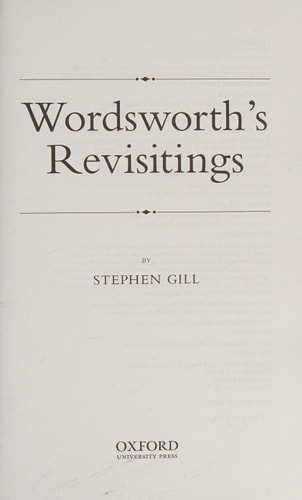
Wordsworth's Revisitings
0
0
As an Amazon Associate and affiliate partner, Menrva Books earns from qualifying purchases. Learn more
Author Description
Nothing was more important to Wordsworth than tracing the evidence that affinities had been preserved between all the stages of the life of man. In this beautifully written and thoughtful book Wordsworth's biographer and editor Stephen Gill explores the ways in which the poet attempted as an artist to maintain such continuities and shows how revisitings of various kinds are at the heart of his creativity. Habitually reviewing all of his work, both published and that still in manuscript, Wordsworth painstakingly revised at the level of verbal detail or recast it more largely. New poems frequently emerged from re-engagement with old, often serving as a sequel to or commentary from the maturer poet on his own earlier creation, and acts of self-borrowing and self-reference are plentiful. These linkings provide insights into the powerful vision the poet maintained that his imaginative creation was one evolving unity and reveal much about the obsessions and drives of the great poet. Combining textual analysis, critical commentary, and biographical narrative, Gill explores what binds Wordsworth's later, less well-known poems to his earlier work. At the centre of the book is an account of the evolution of The Prelude from 1804 to 1839, in which it is argued that Wordsworth's masterpiece must be followed through all its versions, seen as a poem growing old alongside its creator.
Menrva's Summary
THE THESIS
This book investigates how William Wordsworth’s lifelong practice of revisiting and revising his own work served as a fundamental mechanism for maintaining artistic continuity and personal identity. Stephen Gill, a recognized authority on Wordsworth’s life and editorial history, utilizes a combination of textual analysis and biographical narrative to argue that the poet’s creative process was an evolving, unified project. By examining the poet’s habit of self-reference and revision, Gill demonstrates how Wordsworth’s later works function as critical dialogues with his younger self. The study posits that the poet’s oeuvre should be understood as a living entity that matured alongside its creator.
THE SCOPE MAP
What You Will Find
- Detailed analysis of the evolution of The Prelude across its various versions from 1804 to 1839.
- Examination of Wordsworth’s revisionary practices, including verbal adjustments and large-scale recasting of manuscripts.
- Exploration of self-borrowing and self-reference as primary drivers of the poet's creative output.
- Synthesis of biographical narrative and critical commentary to link early and late poetic periods.
THE AUTHORITY PERSPECTIVE
Scholars and literary critics frequently cite this work as a vital resource for understanding the complexities of Wordsworth’s editorial habits and his long-term creative vision. Readers often note the academic rigor of the text, which provides a nuanced perspective on the poet's development for those familiar with his major works.
Page Count:
280
Publication Date:
2011-11-15
Publisher:
Oxford University Press
ISBN-10:
0199268770
ISBN-13:
9780199268771
Biography
Poetry
Literary History
Literary Criticism
Community Tags
Similar Books